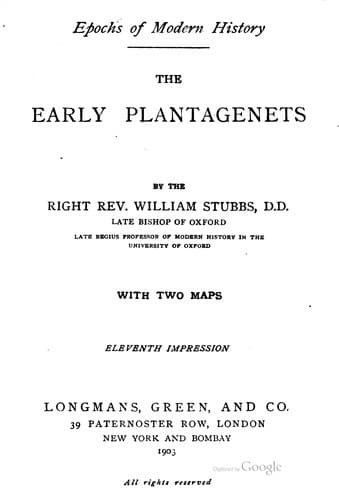
Great Britain -- History -- Plantagenets, 1154-1399; Plantagenet, House of
Henry II. was a very great sovereign in many ways: he was an admirable
soldier, most careful in forming plans, wonderfully rapid in the
execution of them; he was at once cautious and adventurous, sparing
of human life and moderate in the use of victory. Yet he was far from
being a mild or gentle enemy; and he was economical of human life
rather because of its cost in money than from any pitifulness. If he
spared an enemy it was only when he had entirely disabled him from
doing harm, or when he was fully assured of his power to turn him into
a friend. His foes accused him of being treacherous, but his treachery
mainly consisted in letting them deceive themselves. Thus he was no
hero of probity, and his craft may have gone farther in the direction
of cunning than was approved by the rough diplomacy of his time. He
is said to have had a maxim, that it is easier to repent of words
than of deeds, and therefore wiser to break your word than to fulfil
an inconvenient obligation; but it cannot be said that the facts of
history show him to have acted upon this shameless avowal, captious
and unscrupulous as his policy more than once appears. He had no
doubt a difficult part to play. His dominions brought him into close
contact with all the great sovereigns of Europe. He had considerable
ambitions--for himself, to hold fast all that he had acquired by
inheritance and marriage; for his sons to obtain by marriage or other
settlement provinces which, united to their hereditary provision,
might make them either a family of allied sovereigns or an imperial
federation under himself, and in each form the mightiest house in
Christendom. Such a network of design was spread before him from the
first. As the head of the house of Anjou the kings and princes of
Palestine regarded him as their family representative, the grandson
of King Fulk, and the man created for the re-conquest of the East. To
him in their utmost need they sent the offer of their crown, the keys
of the Holy Sepulchre and of the Tower of David. As the head of the
Normans he was looked up to by the Sicilian king as the presumptive
successor, and had the strange fortune and self-restraint to decline
the offer of a second crown. The Italians thought him a likely
competitor for the empire when they saw him negotiating for his son
John a marriage with the heiress of Savoy, which would give him the
command of the passes of the Alps; Spain saw in him the leader of a new
crusade against the Moors when he sought for his son Richard a bribe
in the Princess of Aragon, whose portion would give him the passes of
the Pyrenees. Frederick Barbarossa might well feel suspicious when he
heard that English gold was given to build the walls of Milan, and
when he remembered that Henry the Lion, the great Duke of Saxony and
Bavaria, the head of the Welfic house, his cousin and friend, whom with
heavy heart he had sacrificed to the necessities of state, was also
son-in-law of the king of the English.
Public-domain text, read in full here on John Shaqi.
Reviews
Reviews
No reviews yet
Be the first to share your thoughts on this work.
Join the Discussion
Join the discussion
Sign in to leave a comment or review.
Sign InorCreate an account