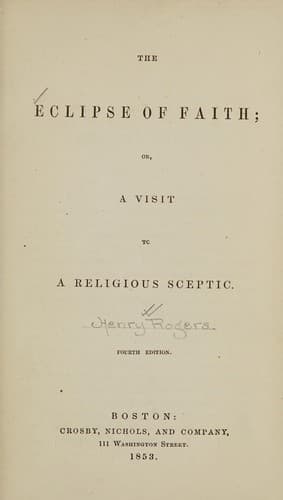
The Eclipse of Faith; Or, A Visit to a Religious ScepticRogers, Henry
Religion
The Eclipse of Faith; Or, A Visit to a Religious Sceptic
Rogers, Henry
Skepticism -- Controversial literature
producing such a fiction as the New Testament; so that, if it be asked
whether it was not possible that some Christians of after times might
have forged these books, one must say with Paley, that they could not.
And by the by, gentlemen, said I, (interrupting my narrative, and
addressing the present company,) I may remind some of you who are
great admirers of Professor Newman, that he admits (as indeed all
must, who have had an opportunity of comparing them) the infinite
inferiority of the Fathers, though he does not attempt to account,
as surely he ought, for so singular a circumstance. He says in his
Phases: "On the whole, this reading [of the Apostolical Fathers]
greatly exalted my sense of the unapproachable greatness of the New
Testament. The moral chasm between it and the very earliest Christian
writers seemed to me so vast, as only to be accounted for by the
doctrine ..... that the New Testament was dictated by the immediate
action of the Holy Spirit." (Phases, p. 25.)
But to resume the statement of my early difficulties. I felt that
the anomalies involved in the theory of the fictitious origin of the
New Testament were almost endless; I said that, however hard to
believe that any men, much less such men as Jews of that age, were
capable of such achievements as I had already specified, I must
believe much more still; for the men, with all their wisdom, were
fools enough to make their enterprise infinitely more hazardous,--by
intrusting the execution of it to a league of many minds, thus
multiplying indefinitely their chances of contradiction; by adopting
every kind and style of composition, full of reciprocal allusions; and,
above all, by dovetailing their fabrications into true history, thus
encountering a perpetual danger of collision between the two; all as
if to accumulate upon their task every difficulty which ingenuity
could devise! Could I believe that such men as those to whom history
restricts the problem had been able, while thus giving every advantage
to the detection of imposture, to invent a narrative so infinitely
varied in form and style, composed by so many different hands,
traversing, in such diversified ways, contemporary characters and
events, involving names of places, dates, and numberless specialities
of circumstance, and yet maintain a general harmony of so peculiar a
kind, such a callida junctura of these most heterogeneous materials,
as to have imposed on the bulk of readers in all ages an impression
of their artless truth and innocence, and that they were writing
facts, and not fictions? Above all, could they be capable of
fabricating those deeply-latent coincidences, which, if fraud
employed them, overreached fraud itself; lying so deep as to be
undiscovered for nearly eighteen centuries, and only recently
attracting the attention of the world in consequence of the objections
of infidels themselves? We know familiarly enough, that to sustain
any verisimilitude in a fictitious history (even though only one
Public-domain text, read in full here on John Shaqi.
Reviews
Reviews
No reviews yet
Be the first to share your thoughts on this work.
Elsewhere in the archive
Join the Discussion
Join the discussion
Sign in to leave a comment or review.
Sign InorCreate an account