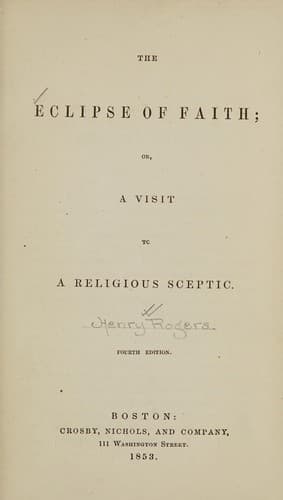
The Eclipse of Faith; Or, A Visit to a Religious ScepticRogers, Henry
Religion
The Eclipse of Faith; Or, A Visit to a Religious Sceptic
Rogers, Henry
Skepticism -- Controversial literature
argument of an event's never having occurred, as never to have seen
that event when it was alleged to have taken place under our very
eyes!"
"I give up the reasoning on this point," said Fellowes, "but how,
I should like to know, do you retort the argument upon him?"
"Thus; you see that we maintain that a miracle is incredible per se,
because impossible; not to be believed, therefore, on any evidence."
"Certainly."
"If, then, we saw what seemed a miracle, we should distrust our senses;
we should say that it was most likely that they deceived us. Hear what
Voltaire says in one of his letters to D'Alembert: 'Je persiste a
penser que cent mille hommes qui ont vu ressusciter un mort, pourraient
bien etre cent mille hommes qui auraient la berlue.' And what he says
of their bad eyes, there is no doubt he would say of his own, if he had
been one of the hundred thousand."
"I think so, certainly."
"And Strauss, and Hume, and Voltaire, and you and I, and all who hold
a miracle impossible, would distrust our senses, and fall back upon
that testimony from the general experience of others, which alone could
correct our own halting and ambiguous experience."
"Certainly."
"It appears, then, my good fellow, that the position of those who
deny and those who assert miracles is exactly the reverse of Hume's
statement. The man who believes 'Transubstantiation' distrusts his
senses, and rather believes testimony: and even so would he who has
fully made up his mind, on our sublime principle as to the
impossibility of miracles, when any thing which has that appearance
crosses his path; he is prepared to deny his senses and to trust
to testimony,--to that general experience of others which comes to
him, and can come to him, only in that shape. It is we, therefore,
and not our adversaries, who are liable to be reached by this
unlucky illustration."
Fellowes himself seemed much amused by finding the tables thus
turned. For my part, I had difficulty in repressing a chuckle over
this display of sceptical candor and subtilty.
"There is perhaps another paradox which may be as well mentioned,"
resumed Harrington. "It is a little trying to my scepticism, but
perhaps will not be to your faith. I mean this. We are constrained
to believe from our 'uniform-experience' criterion that no miracle
has ever occurred, or ever will; in short, it is, as we say,
impossible. Now the principle which undoubtedly leads us to the
conclusion we may regard as a principle of our nature, if ever there
was one; that is, we are so constituted as to infer the perpetual
uniformity of certain sequences of phenomena from our observation
of that uniformity."
"Assuredly."
Public-domain text, read in full here on John Shaqi.
Reviews
Reviews
No reviews yet
Be the first to share your thoughts on this work.
Elsewhere in the archive
Join the Discussion
Join the discussion
Sign in to leave a comment or review.
Sign InorCreate an account