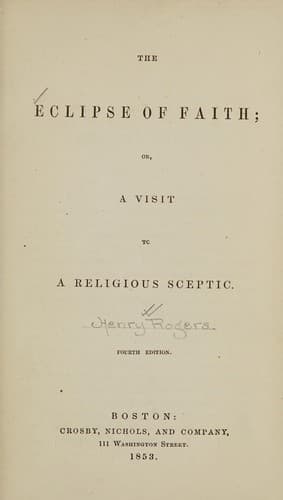
The Eclipse of Faith; Or, A Visit to a Religious ScepticRogers, Henry
Religion
The Eclipse of Faith; Or, A Visit to a Religious Sceptic
Rogers, Henry
Skepticism -- Controversial literature
"Which," said I, "if true, is perhaps the only point in which all
religions are agreed, unless we affirm that they have all recognized a
Deity, because most of them have recognized thousands. Yet as men's
Gods have varied between the Infinite Creator and a monkey, so in
relation to this article of a 'future life,' it must be confessed that
there is a little difference between the Heaven of a Christian, the
Paradise of a Mahometan, and the Valhalla of an ancient Goth. Still,
as you say, it is true that, in some shape or other, nations have
more distinctly recognized the idea of an after existence, than any
other assignable religious tenet."
"You know," resumed Fellowes, "that in the draught of 'natural religion'
given us by Lord Herbert, that writer particularly insists on this as
one of the articles which nature itself teaches us, as amongst the
'common notions,' a sentiment innate to the human mind. Now if such
masters as Mr. Newman may be in doubt about our innate sentiments, truly
I scarcely know what to think."
"You can easily decide," said I, gravely, "and decide infallibly."
"How so?"
"Consult that spiritual faculty which Mr. Newman says you have as
well as he or Lord Herbert. If your theory be true, how can there be
any doubt as to your 'innate' sentiments? If you say they are
written in very small characters, and require to be magnified by
somebody's microscope, that, recollect, is tantamount to
acknowledging the possible utility of an external revelation. But
what next?"
"Well, then, if I must confess all the truth, I thought Mr. Newman
hardly fair in his exhibition of Paul's reasoning on this matter. He,
if you recollect, says that Paul seems to have rested the belief of
Christ's resurrection very little upon evidence, which he received
very credulously, upon very insufficient proof, and in a manner which
would have moved the laughter of Paley; that, in short, he cared very
little about the evidence, and arrived mainly at his convictions in
virtue of his 'spiritual aspirations'; that it was rather his strong
aspirations after immortality which made Paul believe the supposed
fact, than the supposed fact which gave strength to his aspirations
after immortality. Now it is very clear (from texts which, for
whatsoever reasons, are not quoted by Mr. Newman), that the Apostle
Paul made his whole argument depend on the alleged fact of Christ's
resurrection, whether carelessly received or not: 'If Christ be not
risen, then is your faith vain, and our preaching is also vain ....
Then are we of all men most miserable.'"
"But you recollect that Mr. Newman alleges that Paul deals very
superficially with the evidence,--with that of the 'five hundred,' for
example. He observes that Paley would have made a widely different
matter of it."
"See how variously men may argue," replied Fellowes, candidly. "I was
talking on that very point with one of the orthodox the other day, and
he reasoned in some such way as this:--
Public-domain text, read in full here on John Shaqi.
Reviews
Reviews
No reviews yet
Be the first to share your thoughts on this work.
Elsewhere in the archive
Join the Discussion
Join the discussion
Sign in to leave a comment or review.
Sign InorCreate an account