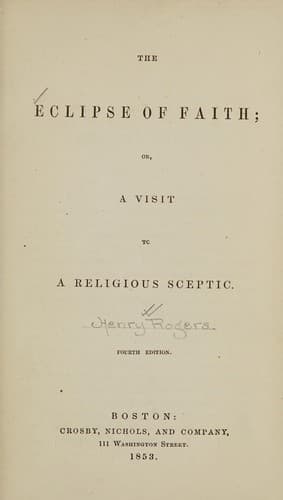
The Eclipse of Faith; Or, A Visit to a Religious ScepticRogers, Henry
Religion
The Eclipse of Faith; Or, A Visit to a Religious Sceptic
Rogers, Henry
Skepticism -- Controversial literature
"On the supposition, he said, that the possession of miraculous powers
was notorious in the Church,--that many of those whom Paul addressed
had actually witnessed them,--that the Gospel, when preached by him
and by the other Apostles, was confirmed by 'signs and wonders,'--nothing
could be more natural than the very tone which the Apostles employed:
that, so far from its being suspicious, it was one of the truest touches
of nature and verisimilitude in their compositions; so much so, that,
supposing there were no miracles, that very tone required itself to be
accounted for as unnatural; he said that it is, in fact, just the way
in which men talk and write of any other extraordinary events which
notoriously happened in their time. They never think of posterity, and
what it may think; of anticipating either future doubts or charges of
fraud. It is natural that men should speak in this, as we should call it,
loose way, of what is transpiring under their very noses. If, on the
other hand, there had been no miracles to appeal to, so as to render
this style as natural as, on the contrary supposition, it was the reverse,
he could not, he said, imagine, that, in that or any other age, any men,
especially men opposed to such pretensions, would so easily have been
satisfied, even had the Apostles confined themselves to rumors of
alleged distant miracles; but much less where similar wonders were said
to have been brought under the eyes of the very parties to whom the
appeal was made! He said he would even go a step further, and affirm that,
under the circumstances of the professed notoriety of the miraculous
occurrences to which Paul and the other Apostles appealed, any
declaration that they had instituted that careful scrutiny of evidence,
that minute circumstantial cross-examination of the witnesses,--which
would be a course all very well in the days of Paley, eighteen hundred
years after, but absolutely preposterous then,--would have appeared to
our age a much more suspicious thing than the tone actually adopted;
that the scrupulous deposition of technical proof would have been
finessing too much, and would have been the strongest proof of collusion.
The very tone objected to, he said, supposing there were no miracles, is
one of the most striking proofs of the astonishing sagacity of these
men; for it is just the tone they would have used if there had been. So
differently may men reason from the same data! Whether (he concluded)
Mr. Newman's view of the facts, or his, was founded on a deeper and more
comprehensive knowledge of human nature, he must leave to my judgment."
"I protest," said I, "I think the orthodox had the best of it. But what
struck you next as unaccountable in Mr. Newman's view of this subject
of a future life?"
Public-domain text, read in full here on John Shaqi.
Reviews
Reviews
No reviews yet
Be the first to share your thoughts on this work.
Elsewhere in the archive
Join the Discussion
Join the discussion
Sign in to leave a comment or review.
Sign InorCreate an account