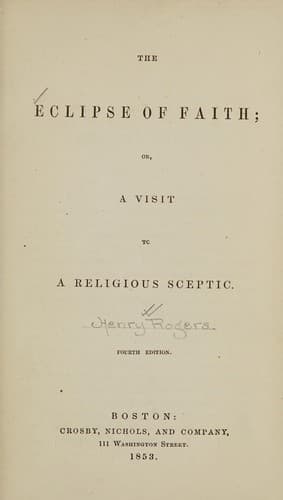
The Eclipse of Faith; Or, A Visit to a Religious ScepticRogers, Henry
Religion
The Eclipse of Faith; Or, A Visit to a Religious Sceptic
Rogers, Henry
Skepticism -- Controversial literature
"I confess, then, that the reasoning by which he endeavors to show
that, even admitting the fact of Christ's resurrection, there could
be nothing in it to warrant the expectation of the resurrection of
any other human beings, simply because he must have differed so
stupendously from all the rest of mankind, appears to me very damaging
to us. Of what use is it, to argue upon such an hypothesis?"
"Of none in the world, certainly," said I, laughing.
"Surely not," he replied; "for if Christ's resurrection be admitted, we
know very well it will carry with it, in the estimation of the bulk of
mankind, all the other great facts implicated with the Christian system.
They will concede, at once, the supernatural character, the divine
origin, of the New Testament. I suppose them scarcely ever was a man
who admitted these premises who would trouble himself to contest the
conclusion."
"But seriously," continued this half-repentant admirer, almost
frightened at the extent of his own freedom of thought, "though I
cannot say I am satisfied with Mr. Newman's notions on this subject,
--and, in fact, cannot make up my mind upon it,--can there be any
thing morally more sublime than the view, that the doctrine of
immortality, which has been superficially supposed, if not necessary,
yet so conducive to sincere and elevated piety, may be readily
dispensed with, as no way necessary (as Mr. Newman feels) for the
spiritual nourishment of the soul? 'Confidence,' he says, 'there is
none; and hopeful aspiration is the soul's highest state. But, then,
there is herein nothing what ever to distress her; no cloud of grief
crosses the area of her vision, as she gazes upwards.' He even
intimates that, from the stress laid upon immortality by 'modern
divines,' they might seem to be 'incarnations of selfishness.' He says
it tends to 'degrade religion into a prudential regard for our interests
after death'; that 'conscience, the love of virtue, for its own sake,
and much more the love of God, are ignored.' Many of the 'spiritual'
school agree with him in this; and some even affirm that the hope of
immortal felicity is but a bribe to selfishness. Can any thing be
more elevated or original than this view?"
Public-domain text, read in full here on John Shaqi.
Reviews
Reviews
No reviews yet
Be the first to share your thoughts on this work.
Elsewhere in the archive
Join the Discussion
Join the discussion
Sign in to leave a comment or review.
Sign InorCreate an account