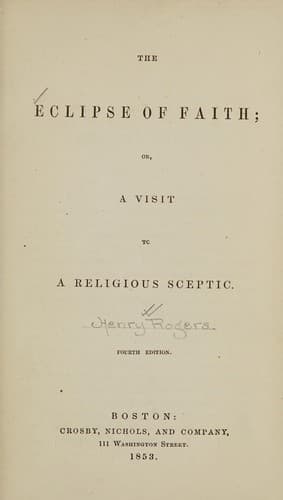
The Eclipse of Faith; Or, A Visit to a Religious ScepticRogers, Henry
Religion
The Eclipse of Faith; Or, A Visit to a Religious Sceptic
Rogers, Henry
Skepticism -- Controversial literature
"As to the elevation," said I, "I confess I prefer the spectacle of
Socrates, relying even on feeble arguments rather than sink to this
tame acquiescence in a notion so degrading to the Deity, as that
man was created for a dog's life with the tormenting aspiration for
something better. The spectacle of the heathen sage, who, amidst the
thick gloom, the 'palpable obscure,' which involved this subject,
gazed intently into the darkness, and 'longed for the day,'--who
strained every nerve of an insufficient logic, and was willing to
take even the whispers of hope for the oracles of truth, rather than
part with the prospect of immortality,--is, to my mind, much more
attractive. As to the originality of the view you just expressed, why,
it is merely a resurrection of one of the theories of some of our
very 'spiritual deists' a century ago. Collins and Shaftesbury were,
in like manner, apprehensive lest an elevated 'virtue' should suffer
at all from this bribery of a hope of a 'blessed immortality'; as you
may see in the Characteristics. For my own part, I certainly have my
doubts whether virtue will be the less virtuous, or spirituality the
less spiritual, for such a doctrine; and I must believe it even on
the hypothesis of you spiritual folks; for you generally affirm that
the Belief of a Future Life does not really exercise any thing more
than an insignificant influence on human nature; the hopes and the
fears of that so distant a morrow are too vague to be operative. Now,
if it be so, immortality can be no more a bribe than a menace."
"Yet," said Fellowes, "in justice to Mr. Newman, it must not be
forgotten, that he thinks that 'a firm belief of immortality must
have very energetic force,' provided it 'rises out of insight'; it
is as 'an external dogma' that he thinks it of little efficacy. He
says, you know, that, supposing Paul to have had this insight, 'his
light can do us no good, while it is a light outside of us. If
he in any way confused the conclusions of his logic (which is often
extremely inconsequent and mistaken) with the perceptions of his
divinely illuminated soul, our belief might prove baseless.'
(Soul, pp. 226. 227.) These are his very words."
"Very well, then; say that Mr. Newman thinks the notions of a future
hell of little efficacy; and of a future heaven of as little, except
when it rises from 'insight';--he confessing that he has not that
'insight,' and; from the necessity of the case, not knowing whether
any body else has, it being a 'light outside him.' If so, I think
he is much like the rest of you, and cannot in fact suppose the
thought of a future life to operate strongly either as a bribe
or a menace."
"But, surely, whatever his views, or those of any individual, you
must admit that a piety which is sustained without any hopes of
immortality is less selfish than that which is."
Public-domain text, read in full here on John Shaqi.
Reviews
Reviews
No reviews yet
Be the first to share your thoughts on this work.
Elsewhere in the archive
Join the Discussion
Join the discussion
Sign in to leave a comment or review.
Sign InorCreate an account