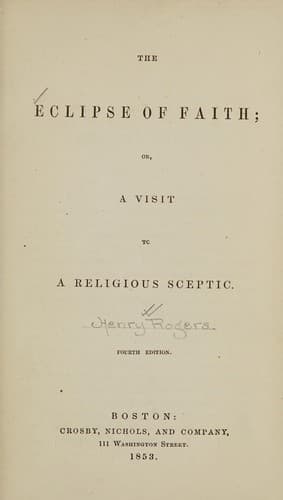
The Eclipse of Faith; Or, A Visit to a Religious ScepticRogers, Henry
Religion
The Eclipse of Faith; Or, A Visit to a Religious Sceptic
Rogers, Henry
Skepticism -- Controversial literature
"Nay," I said, "that is an after consideration; if you can but be
brought to believe that any is true, I know you will believe but one."
"You touched just now," he replied, "on the very difficulty. I shall
believe as soon as any one gives me what you truly say I ask,--
demonstration of the truth of some one of the thousand and one religious
systems which men have believed."
"And that, demonstration," said I, "you cannot have; for God has not
granted demonstration to man on that or any other subject in which
duty is involved."
"But why might I not have had it? and should I not have had it, if it
had been incumbent on me to believe it?"
We had now come to the very knot of the whole argument.
"Incumbent on you to believe! I suppose you mean, if there had been
any system which you could not but believe; which you must believe
whether you would or not. No doubt, in that case, the requisite
evidence would have been such that scepticism would have been
impossible; that word 'incumbent' implies duty; and that word duty
is the key to the whole mystery, for it implies the possibility of
resisting its claims. We do not speak of its being incumbent on a man
to run out of a burning house, or to swim, if he can, when thrown
into deep water. He cannot help it. If there be a Supreme Ruler of the
universe, and if the posture of his intelligent creatures be that of
submissive obedience to him, it is inconceivable that a man can ever
have experience of his being willing to perform that duty with the
sort of demonstration which you demand; and, for aught we know, it
may be impossible, constituted as we are, that we should ever be
actually trained to that duty, except in the midst of very much less
than certainty. Now, if this be so,--and I defy you or any man to
prove that it may not be so,--then we are asking a simple impossibility
when we ask that we may be freed from these conditions; for it is
asking that we may perform our duty, under circumstances which shall
render all duty impossible." I pursued this subject at some length,
and reminded him that the supposed law of our religious condition was
throughout in analogy with that of the entire condition of our present
life, and in conformity with his own rule of the probable; that it is
probable evidence only that is given to man in either case, and
"probable evidence," as Bishop Butler says, "often of even wretchedly
insufficient character." Nature, or rather God himself, everywhere
cries aloud to us, "O mortals! certainty, demonstration, infallibility,
are not for you, and shall not be given to you; for there must be a sphere
for faith, hope, sincerity, diligence, patience." And as if to prove to
us, not only that this evidence is what we must trust to, but that we
safely may, He impels us by strong necessities of our lower nature
operating on the higher (which would otherwise, perhaps, plead for the
sceptic's inaction in relation to this as well as to another world)
Public-domain text, read in full here on John Shaqi.
Reviews
Reviews
No reviews yet
Be the first to share your thoughts on this work.
Elsewhere in the archive
Join the Discussion
Join the discussion
Sign in to leave a comment or review.
Sign InorCreate an account