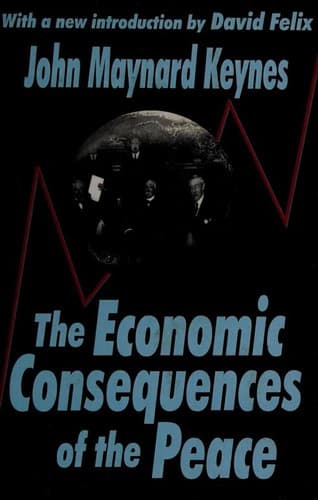
The Economic Consequences of the PeaceKeynes, John Maynard
History
The Economic Consequences of the Peace
Keynes, John Maynard
Economic history -- 1918-1945; Treaty of Versailles (1919 June 28); World War, 1914-1918 -- Economic aspects
Not infrequently Mr. Lloyd George, after delivering a speech in English,
would, during the period of its interpretation into French, cross the
hearthrug to the President to reinforce his case by some _ad hominem_
argument in private conversation, or to sound the ground for a
compromise,--and this would sometimes be the signal for a general
upheaval and disorder. The President's advisers would press round him, a
moment later the British experts would dribble across to learn the
result or see that all was well, and next the French would be there, a
little suspicious lest the others were arranging something behind them,
until all the room were on their feet and conversation was general in
both languages. My last and most vivid impression is of such a
scene--the President and the Prime Minister as the center of a surging
mob and a babel of sound, a welter of eager, impromptu compromises and
counter-compromises, all sound and fury signifying nothing, on what was
an unreal question anyhow, the great issues of the morning's meeting
forgotten and neglected; and Clemenceau silent and aloof on the
outskirts--for nothing which touched the security of France was
forward--throned, in his gray gloves, on the brocade chair, dry in soul
and empty of hope, very old and tired, but surveying the scene with a
cynical and almost impish air; and when at last silence was restored and
the company had returned to their places, it was to discover that he had
disappeared.
He felt about France what Pericles felt of Athens--unique value in her,
nothing else mattering; but his theory of politics was Bismarck's. He
had one illusion--France; and one disillusion--mankind, including
Frenchmen, and his colleagues not least. His principles for the peace
can be expressed simply. In the first place, he was a foremost believer
in the view of German psychology that the German understands and can
understand nothing but intimidation, that he is without generosity or
remorse in negotiation, that there is no advantage he will not take of
you, and no extent to which he will not demean himself for profit, that
he is without honor, pride, or mercy. Therefore you must never negotiate
with a German or conciliate him; you must dictate to him. On no other
terms will he respect you, or will you prevent him from cheating you.
But it is doubtful how far he thought these characteristics peculiar to
Germany, or whether his candid view of some other nations was
fundamentally different. His philosophy had, therefore, no place for
"sentimentality" in international relations. Nations are real things, of
whom you love one and feel for the rest indifference--or hatred. The
glory of the nation you love is a desirable end,--but generally to be
obtained at your neighbor's expense. The politics of power are
inevitable, and there is nothing very new to learn about this war or the
end it was fought for; England had destroyed, as in each preceding
Public-domain text, read in full here on John Shaqi.
Reviews
Reviews
No reviews yet
Be the first to share your thoughts on this work.
Join the Discussion
Join the discussion
Sign in to leave a comment or review.
Sign InorCreate an account