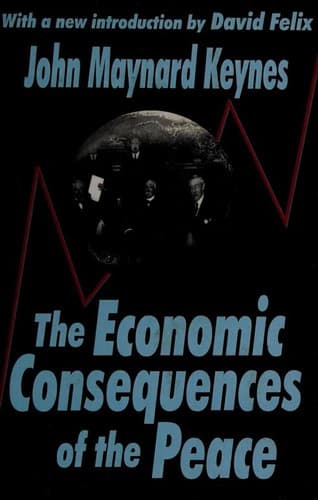
The Economic Consequences of the PeaceKeynes, John Maynard
History
The Economic Consequences of the Peace
Keynes, John Maynard
Economic history -- 1918-1945; Treaty of Versailles (1919 June 28); World War, 1914-1918 -- Economic aspects
century, a trade rival; a mighty chapter had been closed in the secular
struggle between the glories of Germany and of France. Prudence required
some measure of lip service to the "ideals" of foolish Americans and
hypocritical Englishmen; but it would be stupid to believe that there is
much room in the world, as it really is, for such affairs as the League
of Nations, or any sense in the principle of self-determination except
as an ingenious formula for rearranging the balance of power in one's
own interests.
These, however, are generalities. In tracing the practical details of
the Peace which he thought necessary for the power and the security of
France, we must go back to the historical causes which had operated
during his lifetime. Before the Franco-German war the populations of
France and Germany were approximately equal; but the coal and iron and
shipping of Germany were in their infancy, and the wealth of France was
greatly superior. Even after the loss of Alsace-Lorraine there was no
great discrepancy between the real resources of the two countries. But
in the intervening period the relative position had changed completely.
By 1914 the population of Germany was nearly seventy per cent in excess
of that of France; she had become one of the first manufacturing and
trading nations of the world; her technical skill and her means for the
production of future wealth were unequaled. France on the other hand had
a stationary or declining population, and, relatively to others, had
fallen seriously behind in wealth and in the power to produce it.
Public-domain text, read in full here on John Shaqi.
Reviews
Reviews
No reviews yet
Be the first to share your thoughts on this work.
Join the Discussion
Join the discussion
Sign in to leave a comment or review.
Sign InorCreate an account