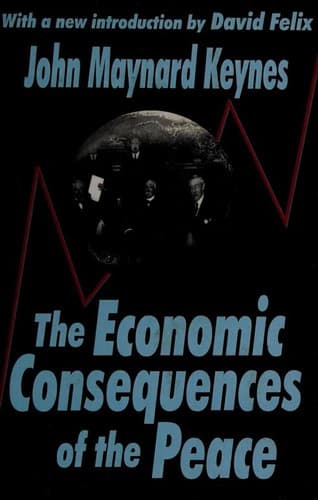
The Economic Consequences of the PeaceKeynes, John Maynard
History
The Economic Consequences of the Peace
Keynes, John Maynard
Economic history -- 1918-1945; Treaty of Versailles (1919 June 28); World War, 1914-1918 -- Economic aspects
_New York, September 27_.--(1) "The impartial justice meted out must
involve no discrimination between those to whom we wish to be just and
those to whom we do not wish to be just." (2) "No special or separate
interest of any single nation or any group of nations can be made the
basis of any part of the settlement which is not consistent with the
common interest of all." (3) "There can be no leagues or alliances or
special covenants and understandings within the general and common
family of the League of Nations." (4) "There can be no special selfish
economic combinations within the League and no employment of any form of
economic boycott or exclusion, except as the power of economic penalty
by exclusion from the markets of the world may be vested in the League
of Nations itself as a means of discipline and control." (5) "All
international agreements and treaties of every kind must be made known
in their entirety to the rest of the world."
This wise and magnanimous program for the world had passed on November
5, 1918 beyond the region of idealism and aspiration, and had become
part of a solemn contract to which all the Great Powers of the world had
put their signature. But it was lost, nevertheless, in the morass of
Paris;--the spirit of it altogether, the letter in parts ignored and in
other parts distorted.
The German observations on the draft Treaty of Peace were largely a
comparison between the terms of this understanding, on the basis of
which the German nation had agreed to lay down its arms, and the actual
provisions of the document offered them for signature thereafter. The
German commentators had little difficulty in showing that the draft
Treaty constituted a breach of engagements and of international morality
comparable with their own offense in the invasion of Belgium.
Nevertheless, the German reply was not in all its parts a document fully
worthy of the occasion, because in spite of the justice and importance
of much of its contents, a truly broad treatment and high dignity of
outlook were a little wanting, and the general effect lacks the simple
treatment, with the dispassionate objectivity of despair which the deep
passions of the occasion might have evoked. The Allied governments gave
it, in any case, no serious consideration, and I doubt if anything which
the German delegation could have said at that stage of the proceedings
would have much influenced the result.
The commonest virtues of the individual are often lacking in the
spokesmen of nations; a statesman representing not himself but his
country may prove, without incurring excessive blame--as history often
records--vindictive, perfidious, and egotistic. These qualities are
familiar in treaties imposed by victors. But the German delegation did
not succeed in exposing in burning and prophetic words the quality which
chiefly distinguishes this transaction from all its historical
predecessors--its insincerity.
Public-domain text, read in full here on John Shaqi.
Reviews
Reviews
No reviews yet
Be the first to share your thoughts on this work.
Join the Discussion
Join the discussion
Sign in to leave a comment or review.
Sign InorCreate an account