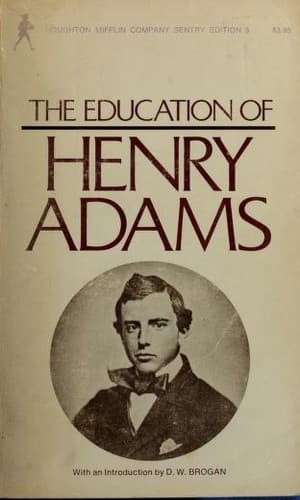
Adams, Henry, 1838-1918; Historians -- United States -- Biography
Russell alone insisted on his honesty of intention and
persuaded both the Duke and the Minister to believe him. Every one in
the Legation accepted his assurances as the only assertions they could
venture to trust. They knew he expected the rebels to win in the end,
but they believed he would not actively interpose to decide it. On
that--on nothing else--they rested their frail hopes of remaining a day
longer in England. Minister Adams remained six years longer in England;
then returned to America to lead a busy life till he died in 1886 still
holding the same faith in Earl Russell, who had died in 1878. In 1889,
Spencer Walpole published the official life of Earl Russell, and told a
part of the story which had never been known to the Minister and which
astounded his son, who burned with curiosity to know what his father
would have said of it.
The story was this: The Alabama escaped, by Russell's confessed
negligence, on July 28, 1862. In America the Union armies had suffered
great disasters before Richmond and at the second Bull Run, August
29-30, followed by Lee's invasion of Maryland, September 7, the news of
which, arriving in England on September 14, roused the natural idea
that the crisis was at hand. The next news was expected by the
Confederates to announce the fall of Washington or Baltimore.
Palmerston instantly, September 14, wrote to Russell: "If this should
happen, would it not be time for us to consider whether in such a state
of things England and France might not address the contending parties
and recommend an arrangement on the basis of separation?"
This letter, quite in the line of Palmerston's supposed
opinions, would have surprised no one, if it had been communicated to
the Legation; and indeed, if Lee had captured Washington, no one could
have blamed Palmerston for offering intervention. Not Palmerston's
letter but Russell's reply, merited the painful attention of a young
man seeking a moral standard for judging politicians:--
GOTHA, September, 17, 1862
MY DEAR PALMERSTON:--
Whether the Federal army is destroyed or not, it is clear
that it is driven back to Washington and has made no progress
in subduing the insurgent States. Such being the case, I agree
with you that the time is come for offering mediation to the
United States Government with a view to the recognition of the
independence of the Confederates. I agree further that in case
of failure, we ought ourselves to recognize the Southern States
as an independent State. For the purpose of taking so important
a step, I think we must have a meeting of the Cabinet. The 23d
or 30th would suit me for the meeting.
We ought then, if we agree on such a step, to propose it
first to France, and then on the part of England and France, to
Russia and other powers, as a measure decided upon by us.
Public-domain text, read in full here on John Shaqi.
Reviews
Reviews
No reviews yet
Be the first to share your thoughts on this work.
Elsewhere in the archive
Join the Discussion
Join the discussion
Sign in to leave a comment or review.
Sign InorCreate an account