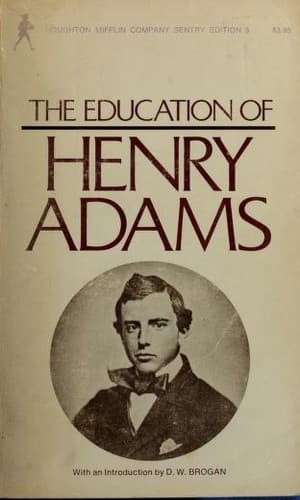
Adams, Henry, 1838-1918; Historians -- United States -- Biography
We ought to make ourselves safe in Canada, not by sending
more troops there, but by concentrating those we have in a few
defensible posts before the winter sets in....
Here, then, appeared in its fullest force, the practical
difficulty in education which a mere student could never overcome; a
difficulty not in theory, or knowledge, or even want of experience, but
in the sheer chaos of human nature. Lord Russell's course had been
consistent from the first, and had all the look of rigid determination
to recognize the Southern Confederacy "with a view" to breaking up the
Union. His letter of September 17 hung directly on his encouragement of
the Alabama and his protection of the rebel navy; while the whole of
his plan had its root in the Proclamation of Belligerency, May 13,
1861. The policy had every look of persistent forethought, but it took
for granted the deliberate dishonesty of three famous men: Palmerston,
Russell, and Gladstone. This dishonesty, as concerned Russell, was
denied by Russell himself, and disbelieved by Argyll, Forster, and most
of America's friends in England, as well as by Minister Adams. What the
Minister would have thought had he seen this letter of September 17,
his son would have greatly liked to know, but he would have liked still
more to know what the Minister would have thought of Palmerston's
answer, dated September 23:--
... It is evident that a great conflict is taking place to
the northwest of Washington, and its issue must have a great
effect on the state of affairs. If the Federals sustain a great
defeat, they may be at once ready for mediation, and the iron
should be struck while it is hot. If, on the other hand, they
should have the best of it, we may wait a while and see what
may follow...
The roles were reversed. Russell wrote what was expected from
Palmerston, or even more violently; while Palmerston wrote what was
expected from Russell, or even more temperately. The private
secretary's view had been altogether wrong, which would not have much
surprised even him, but he would have been greatly astonished to learn
that the most confidential associates of these men knew little more
about their intentions than was known in the Legation. The most trusted
member of the Cabinet was Lord Granville, and to him Russell next
wrote. Granville replied at once decidedly opposing recognition of the
Confederacy, and Russell sent the reply to Palmerston, who returned it
October 2, with the mere suggestion of waiting for further news from
America. At the same time Granville wrote to another member of the
Cabinet, Lord Stanley of Alderley, a letter published forty years
afterwards in Granville's "Life" (I, 442) to the private secretary
altogether the most curious and instructive relic of the whole lesson
in politics:
Public-domain text, read in full here on John Shaqi.
Reviews
Reviews
No reviews yet
Be the first to share your thoughts on this work.
Elsewhere in the archive
Join the Discussion
Join the discussion
Sign in to leave a comment or review.
Sign InorCreate an account