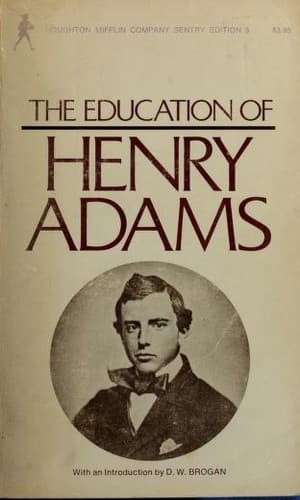
Adams, Henry, 1838-1918; Historians -- United States -- Biography
their plan for breaking up the Union, and had yielded at last only in
the jaws of war. After a long and desperate struggle, the American
Minister had trumped their best card and won the game.
Again and again, in after life, he went back over the ground to
see whether he could detect error on either side. He found none. At
every stage the steps were both probable and proved. All the more he
was disconcerted that Russell should indignantly and with growing
energy, to his dying day, deny and resent the axiom of Adams's whole
contention, that from the first he meant to break up the Union. Russell
affirmed that he meant nothing of the sort; that he had meant nothing
at all; that he meant to do right; that he did not know what he meant.
Driven from one defence after another, he pleaded at last, like
Gladstone, that he had no defence. Concealing all he could
conceal--burying in profound secrecy his attempt to break up the Union
in the autumn of 1862--he affirmed the louder his scrupulous good
faith. What was worse for the private secretary, to the total derision
and despair of the lifelong effort for education, as the final result
of combined practice, experience, and theory--he proved it.
Henry Adams had, as he thought, suffered too much from Russell
to admit any plea in his favor; but he came to doubt whether this
admission really favored him. Not until long after Earl Russell's death
was the question reopened. Russell had quitted office in 1866; he died
in 1878; the biography was published in 1889. During the Alabama
controversy and the Geneva Conference in 1872, his course as Foreign
Secretary had been sharply criticised, and he had been compelled to see
England pay more than L3,000,000 penalty for his errors. On the other
hand, he brought forward--or his biographer for him--evidence tending
to prove that he was not consciously dishonest, and that he had, in
spite of appearances, acted without collusion, agreement, plan, or
policy, as far as concerned the rebels. He had stood alone, as was his
nature. Like Gladstone, he had thought himself right.
In the end, Russell entangled himself in a hopeless ball of
admissions, denials, contradictions, and resentments which led even his
old colleagues to drop his defence, as they dropped Gladstone's; but
this was not enough for the student of diplomacy who had made a certain
theory his law of life, and wanted to hold Russell up against himself;
to show that he had foresight and persistence of which he was unaware.
The effort became hopeless when the biography in 1889 published papers
which upset all that Henry Adams had taken for diplomatic education;
yet he sat down once more, when past sixty years old, to see whether he
could unravel the skein.
Public-domain text, read in full here on John Shaqi.
Reviews
Reviews
No reviews yet
Be the first to share your thoughts on this work.
Elsewhere in the archive
Join the Discussion
Join the discussion
Sign in to leave a comment or review.
Sign InorCreate an account