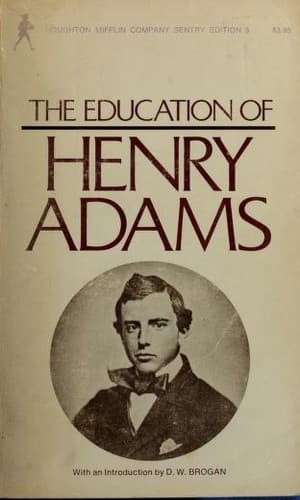
Adams, Henry, 1838-1918; Historians -- United States -- Biography
To reconstruct, when past sixty, an education useful for any
practical purpose, is no practical problem, and Adams saw no use in
attacking it as only theoretical. He no longer cared whether he
understood human nature or not; he understood quite as much of it as he
wanted; but he found in the "Life of Gladstone" (II, 464) a remark
several times repeated that gave him matter for curious thought. "I
always hold," said Mr. Gladstone, "that politicians are the men whom,
as a rule, it is most difficult to comprehend"; and he added, by way of
strengthening it: "For my own part, I never have thus understood, or
thought I understood, above one or two."
Earl Russell was certainly not one of the two.
Henry Adams thought he also had understood one or two; but the
American type was more familiar. Perhaps this was the sufficient result
of his diplomatic education; it seemed to be the whole.
CHAPTER XII
ECCENTRICITY (1863)
KNOWLEDGE of human nature is the beginning and end of political
education, but several years of arduous study in the neighborhood of
Westminster led Henry Adams to think that knowledge of English human
nature had little or no value outside of England. In Paris, such a
habit stood in one's way; in America, it roused all the instincts of
native jealousy. The English mind was one-sided, eccentric,
systematically unsystematic, and logically illogical. The less one knew
of it, the better.
This heresy, which scarcely would have been allowed to
penetrate a Boston mind--it would, indeed, have been shut out by
instinct as a rather foolish exaggeration--rested on an experience
which Henry Adams gravely thought he had a right to think
conclusive--for him. That it should be conclusive for any one else
never occurred to him, since he had no thought of educating anybody
else. For him--alone--the less English education he got, the better!
For several years, under the keenest incitement to
watchfulness, he observed the English mind in contact with itself and
other minds. Especially with the American the contact was interesting
because the limits and defects of the American mind were one of the
favorite topics of the European. From the old-world point of view, the
American had no mind; he had an economic thinking-machine which could
work only on a fixed line. The American mind exasperated the European
as a buzz-saw might exasperate a pine forest. The English mind disliked
the French mind because it was antagonistic, unreasonable, perhaps
hostile, but recognized it as at least a thought. The American mind was
not a thought at all; it was a convention, superficial, narrow, and
ignorant; a mere cutting instrument, practical, economical, sharp, and
direct.
Public-domain text, read in full here on John Shaqi.
Reviews
Reviews
No reviews yet
Be the first to share your thoughts on this work.
Elsewhere in the archive
Join the Discussion
Join the discussion
Sign in to leave a comment or review.
Sign InorCreate an account