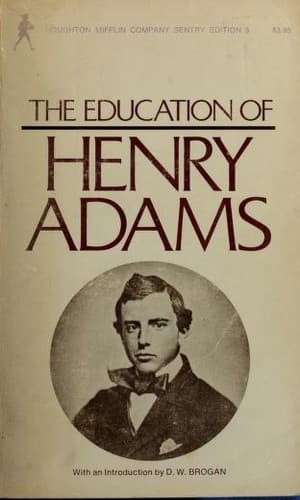
Adams, Henry, 1838-1918; Historians -- United States -- Biography
The English themselves hardly conceived that their mind was
either economical, sharp, or direct; but the defect that most struck an
American was its enormous waste in eccentricity. Americans needed and
used their whole energy, and applied it with close economy; but English
society was eccentric by law and for sake of the eccentricity itself.
The commonest phrase overheard at an English club or
dinner-table was that So-and-So "is quite mad." It was no offence to
So-and-So; it hardly distinguished him from his fellows; and when
applied to a public man, like Gladstone, it was qualified by epithets
much more forcible. Eccentricity was so general as to become hereditary
distinction. It made the chief charm of English society as well as its
chief terror.
The American delighted in Thackeray as a satirist, but
Thackeray quite justly maintained that he was not a satirist at all,
and that his pictures of English society were exact and good-natured.
The American, who could not believe it, fell back on Dickens, who, at
all events, had the vice of exaggeration to extravagance, but Dickens's
English audience thought the exaggeration rather in manner or style,
than in types. Mr. Gladstone himself went to see Sothern act Dundreary,
and laughed till his face was distorted--not because Dundreary was
exaggerated, but because he was ridiculously like the types that
Gladstone had seen--or might have seen--in any club in Pall Mall.
Society swarmed with exaggerated characters; it contained little else.
Often this eccentricity bore all the marks of strength; perhaps
it was actual exuberance of force, a birthmark of genius. Boston
thought so. The Bostonian called it national character--native
vigor--robustness--honesty--courage. He respected and feared it.
British self-assertion, bluff, brutal, blunt as it was, seemed to him a
better and nobler thing than the acuteness of the Yankee or the polish
of the Parisian. Perhaps he was right.
These questions of taste, of feeling, of inheritance, need no
settlement. Every one carries his own inch-rule of taste, and amuses
himself by applying it, triumphantly, wherever he travels. Whatever
others thought, the cleverest Englishmen held that the national
eccentricity needed correction, and were beginning to correct it. The
savage satires of Dickens and the gentler ridicule of Matthew Arnold
against the British middle class were but a part of the rebellion, for
the middle class were no worse than their neighbors in the eyes of an
American in 1863; they were even a very little better in the sense that
one could appeal to their interests, while a university man, like
Gladstone, stood outside of argument. From none of them could a young
American afford to borrow ideas.
Public-domain text, read in full here on John Shaqi.
Reviews
Reviews
No reviews yet
Be the first to share your thoughts on this work.
Elsewhere in the archive
Join the Discussion
Join the discussion
Sign in to leave a comment or review.
Sign InorCreate an account