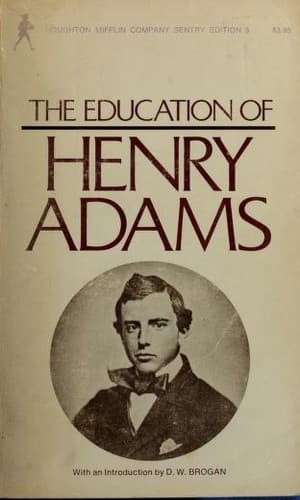
Adams, Henry, 1838-1918; Historians -- United States -- Biography
The private secretary, like every other Bostonian, began by
regarding British eccentricity as a force. Contact with it, in the
shape of Palmerston, Russell, and Gladstone, made him hesitate; he saw
his own national type--his father, Weed, Evarts, for instance--deal
with the British, and show itself certainly not the weaker; certainly
sometimes the stronger. Biassed though he were, he could hardly be
biassed to such a degree as to mistake the effects of force on others,
and while--labor as he might--Earl Russell and his state papers seemed
weak to a secretary, he could not see that they seemed strong to
Russell's own followers. Russell might be dishonest or he might be
merely obtuse--the English type might be brutal or might be only
stupid--but strong, in either case, it was not, nor did it seem strong
to Englishmen.
Eccentricity was not always a force; Americans were deeply interested
in deciding whether it was always a weakness. Evidently, on the
hustings or in Parliament, among eccentricities, eccentricity was at
home; but in private society the question was not easy to answer. That
English society was infinitely more amusing because of its
eccentricities, no one denied. Barring the atrocious insolence and
brutality which Englishmen and especially Englishwomen showed to each
other--very rarely, indeed, to foreigners--English society was much
more easy and tolerant than American. One must expect to be treated
with exquisite courtesy this week and be totally forgotten the next,
but this was the way of the world, and education consisted in learning
to turn one's back on others with the same unconscious indifference
that others showed among themselves. The smart of wounded vanity lasted
no long time with a young man about town who had little vanity to
smart, and who, in his own country, would have found himself in no
better position. He had nothing to complain of. No one was ever brutal
to him. On the contrary, he was much better treated than ever he was
likely to be in Boston--let alone New York or Washington--and if his
reception varied inconceivably between extreme courtesy and extreme
neglect, it merely proved that he had become, or was becoming, at home.
Not from a sense of personal griefs or disappointments did he labor
over this part of the social problem, but only because his education
was becoming English, and the further it went, the less it promised.
Public-domain text, read in full here on John Shaqi.
Reviews
Reviews
No reviews yet
Be the first to share your thoughts on this work.
Elsewhere in the archive
Join the Discussion
Join the discussion
Sign in to leave a comment or review.
Sign InorCreate an account