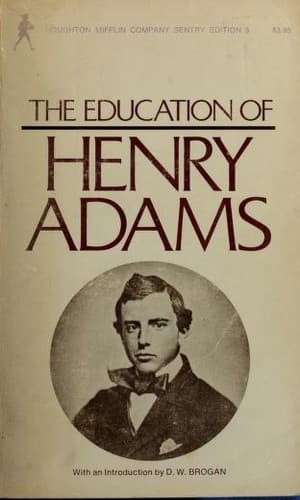
Adams, Henry, 1838-1918; Historians -- United States -- Biography
By natural affinity the social eccentrics commonly sympathized
with political eccentricity. The English mind took naturally to
rebellion--when foreign--and it felt particular confidence in the
Southern Confederacy because of its combined attributes--foreign
rebellion of English blood--which came nearer ideal eccentricity than
could be reached by Poles, Hungarians, Italians or Frenchmen. All the
English eccentrics rushed into the ranks of rebel sympathizers, leaving
few but well-balanced minds to attach themselves to the cause of the
Union. None of the English leaders on the Northern side were marked
eccentrics. William E. Forster was a practical, hard-headed
Yorkshireman, whose chief ideals in politics took shape as working
arrangements on an economical base. Cobden, considering the one-sided
conditions of his life, was remarkably well balanced. John Bright was
stronger in his expressions than either of them, but with all his
self-assertion he stuck to his point, and his point was practical. He
did not, like Gladstone, box the compass of thought; "furiously
earnest," as Monckton Milnes said, "on both sides of every question";
he was rather, on the whole, a consistent conservative of the old
Commonwealth type, and seldom had to defend inconsistencies. Monckton
Milnes himself was regarded as an eccentric, chiefly by those who did
not know him, but his fancies and hobbies were only ideas a little in
advance of the time; his manner was eccentric, but not his mind, as any
one could see who read a page of his poetry. None of them, except
Milnes, was a university man. As a rule, the Legation was troubled very
little, if at all, by indiscretions, extravagances, or contradictions
among its English friends. Their work was largely judicious, practical,
well considered, and almost too cautious. The "cranks" were all rebels,
and the list was portentous. Perhaps it might be headed by old Lord
Brougham, who had the audacity to appear at a July 4th reception at the
Legation, led by Joe Parkes, and claim his old credit as "Attorney
General to Mr. Madison." The Church was rebel, but the dissenters were
mostly with the Union. The universities were rebel, but the university
men who enjoyed most public confidence--like Lord Granville, Sir George
Cornewall Lewis, Lord Stanley, Sir George Grey--took infinite pains to
be neutral for fear of being thought eccentric. To most observers, as
well as to the Times, the Morning Post, and the Standard, a vast
majority of the English people seemed to follow the professional
eccentrics; even the emotional philanthropists took that direction;
Lord Shaftesbury and Carlyle, Fowell Buxton, and Gladstone, threw their
sympathies on the side which they should naturally have opposed, and
did so for no reason except their eccentricity; but the "canny" Scots
and Yorkshiremen were cautious.
Public-domain text, read in full here on John Shaqi.
Reviews
Reviews
No reviews yet
Be the first to share your thoughts on this work.
Elsewhere in the archive
Join the Discussion
Join the discussion
Sign in to leave a comment or review.
Sign InorCreate an account