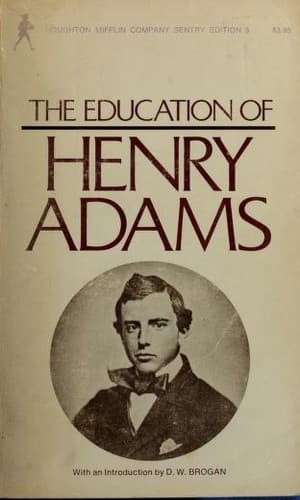
Adams, Henry, 1838-1918; Historians -- United States -- Biography
routine of every young American in a Legation; all counting for nothing
in sum, because, even if it had been his official duty--which it was
not--it was mere routine, a single, continuous, unbroken act, which led
to nothing and nowhere except Portland Place and the grave.
The path that led somewhere was the English habit of mind which
deepened its ruts every day. The English mind was like the London
drawing-room, a comfortable and easy spot, filled with bits and
fragments of incoherent furnitures, which were never meant to go
together, and could be arranged in any relation without making a whole,
except by the square room. Philosophy might dispute about innate ideas
till the stars died out in the sky, but about innate tastes no one,
except perhaps a collie dog, has the right to doubt; least of all, the
Englishman, for his tastes are his being; he drifts after them as
unconsciously as a honey-bee drifts after his flowers, and, in England,
every one must drift with him. Most young Englishmen drifted to the
race-course or the moors or the hunting-field; a few towards books; one
or two followed some form of science; and a number took to what, for
want of a better name, they called Art. Young Adams inherited a certain
taste for the same pursuit from his father who insisted that he had it
not, because he could not see what his son thought he saw in Turner.
The Minister, on the other hand, carried a sort of aesthetic rag-bag of
his own, which he regarded as amusement, and never called art. So he
would wander off on a Sunday to attend service successively in all the
city churches built by Sir Christopher Wren; or he would disappear from
the Legation day after day to attend coin sales at Sotheby's, where his
son attended alternate sales of drawings, engravings, or water-colors.
Neither knew enough to talk much about the other's tastes, but the only
difference between them was a slight difference of direction. The
Minister's mind like his writings showed a correctness of form and line
that his son would have been well pleased had he inherited.
Of all supposed English tastes, that of art was the most
alluring and treacherous. Once drawn into it, one had small chance of
escape, for it had no centre or circumference, no beginning, middle, or
end, no origin, no object, and no conceivable result as education. In
London one met no corrective. The only American who came by, capable of
teaching, was William Hunt, who stopped to paint the portrait of the
Minister which now completes the family series at Harvard College. Hunt
talked constantly, and was, or afterwards became, a famous teacher, but
Henry Adams did not know enough to learn. Perhaps, too, he had
inherited or acquired a stock of tastes, as young men must, which he
was slow to outgrow. Hunt had no time to sweep out the rubbish of
Adams's mind. The portrait finished, he went.
Public-domain text, read in full here on John Shaqi.
Reviews
Reviews
No reviews yet
Be the first to share your thoughts on this work.
Elsewhere in the archive
Join the Discussion
Join the discussion
Sign in to leave a comment or review.
Sign InorCreate an account