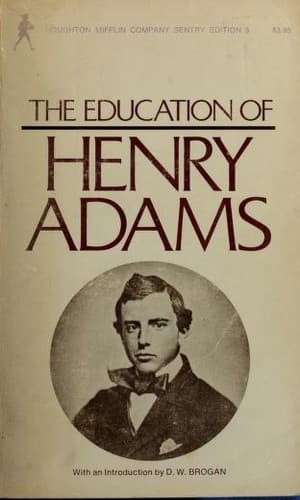
Adams, Henry, 1838-1918; Historians -- United States -- Biography
As often as he could, Adams ran over to Paris, for sunshine,
and there always sought out Richardson in his attic in the Rue du Bac,
or wherever he lived, and they went off to dine at the Palais Royal,
and talk of whatever interested the students of the Beaux Arts.
Richardson, too, had much to say, but had not yet seized his style.
Adams caught very little of what lay in his mind, and the less,
because, to Adams, everything French was bad except the restaurants,
while the continuous life in England made French art seem worst of all.
This did not prove that English art, in 1866, was good; far from it;
but it helped to make bric-a-brac of all art, after the manner of
England.
Not in the Legation, or in London, but in Yorkshire at Thornes,
Adams met the man that pushed him furthest in this English garden of
innate disorder called taste. The older daughter of the Milnes Gaskells
had married Francis Turner Palgrave. Few Americans will ever ask
whether any one has described the Palgraves, but the family was one of
the most describable in all England at that day. Old Sir Francis, the
father, had been much the greatest of all the historians of early
England, the only one who was un-English; and the reason of his
superiority lay in his name, which was Cohen, and his mind which was
Cohen also, or at least not English. He changed his name to Palgrave in
order to please his wife. They had a band of remarkable sons: Francis
Turner, Gifford, Reginald, Inglis; all of whom made their mark. Gifford
was perhaps the most eccentric, but his "Travels" in Arabia were
famous, even among the famous travels of that generation. Francis
Turner--or, as he was commonly called, Frank Palgrave--unable to work
off his restlessness in travel like Gifford, and stifled in the
atmosphere of the Board of Education, became a critic. His art
criticisms helped to make the Saturday Review a terror to the British
artist. His literary taste, condensed into the "Golden Treasury,"
helped Adams to more literary education than he ever got from any taste
of his own. Palgrave himself held rank as one of the minor poets; his
hymns had vogue. As an art-critic he was too ferocious to be liked;
even Holman Hunt found his temper humorous; among many rivals, he may
perhaps have had a right to claim the much-disputed rank of being the
most unpopular man in London; but he liked to teach, and asked only for
a docile pupil. Adams was docile enough, for he knew nothing and liked
to listen. Indeed, he had to listen, whether he liked or not, for
Palgrave's voice was strident, and nothing could stop him. Literature,
painting, sculpture, architecture were open fields for his attacks,
which were always intelligent if not always kind, and when these
failed, he readily descended to meaner levels. John Richard Green, who
was Palgrave's precise opposite, and whose Irish charm of touch and
humor defended him from most assaults, used to tell with delight of
Public-domain text, read in full here on John Shaqi.
Reviews
Reviews
No reviews yet
Be the first to share your thoughts on this work.
Elsewhere in the archive
Join the Discussion
Join the discussion
Sign in to leave a comment or review.
Sign InorCreate an account