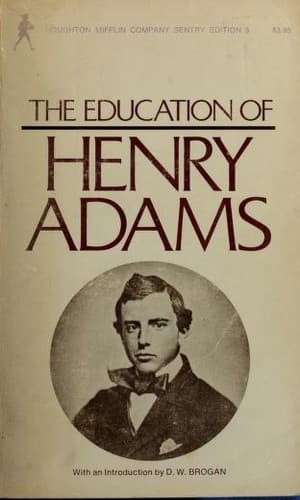
Adams, Henry, 1838-1918; Historians -- United States -- Biography
What was worse, no one had a right to denounce the English as
wrong. Artistically their mind was scrappy, and every one knew it, but
perhaps thought itself, history, and nature, were scrappy, and ought to
be studied so. Turning from British art to British literature, one met
the same dangers. The historical school was a playground of traps and
pitfalls. Fatally one fell into the sink of history--antiquarianism.
For one who nourished a natural weakness for what was called history,
the whole of British literature in the nineteenth century was
antiquarianism or anecdotage, for no one except Buckle had tried to
link it with ideas, and commonly Buckle was regarded as having failed.
Macaulay was the English historian. Adams had the greatest admiration
for Macaulay, but he felt that any one who should even distantly
imitate Macaulay would perish in self-contempt. One might as well
imitate Shakespeare. Yet evidently something was wrong here, for the
poet and the historian ought to have different methods, and Macaulay's
method ought to be imitable if it were sound; yet the method was more
doubtful than the style. He was a dramatist; a painter; a poet, like
Carlyle. This was the English mind, method, genius, or whatever one
might call it; but one never could quite admit that the method which
ended in Froude and Kinglake could be sound for America where passion
and poetry were eccentricities. Both Froude and Kinglake, when one met
them at dinner, were very agreeable, very intelligent; and perhaps the
English method was right, and art fragmentary by essence. History, like
everything else, might be a field of scraps, like the refuse about a
Staffordshire iron-furnace. One felt a little natural reluctance to
decline and fall like Silas Wegg on the golden dust-heap of British
refuse; but if one must, one could at least expect a degree from Oxford
and the respect of the Athenaeum Club.
Public-domain text, read in full here on John Shaqi.
Reviews
Reviews
No reviews yet
Be the first to share your thoughts on this work.
Elsewhere in the archive
Join the Discussion
Join the discussion
Sign in to leave a comment or review.
Sign InorCreate an account