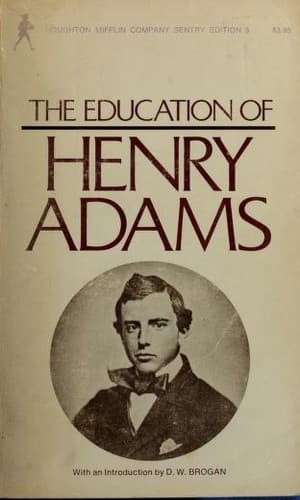
Adams, Henry, 1838-1918; Historians -- United States -- Biography
While drifting, after the war ended, many old American friends
came abroad for a holiday, and among the rest, Dr. Palfrey, busy with
his "History of New England." Of all the relics of childhood, Dr.
Palfrey was the most sympathetic, and perhaps the more so because he,
too, had wandered into the pleasant meadows of antiquarianism, and had
forgotten the world in his pursuit of the New England Puritan. Although
America seemed becoming more and more indifferent to the Puritan except
as a slightly rococo ornament, he was only the more amusing as a study
for the Monkbarns of Boston Bay, and Dr. Palfrey took him seriously, as
his clerical education required. His work was rather an Apologia in the
Greek sense; a justification of the ways of God to Man, or, what was
much the same thing, of Puritans to other men; and the task of
justification was onerous enough to require the occasional relief of a
contrast or scapegoat. When Dr. Palfrey happened on the picturesque but
unpuritanic figure of Captain John Smith, he felt no call to beautify
Smith's picture or to defend his moral character; he became impartial
and penetrating. The famous story of Pocahontas roused his latent New
England scepticism. He suggested to Adams, who wanted to make a
position for himself, that an article in the North American Review on
Captain John Smith's relations with Pocahontas would attract as much
attention, and probably break as much glass, as any other stone that
could be thrown by a beginner. Adams could suggest nothing better. The
task seemed likely to be amusing. So he planted himself in the British
Museum and patiently worked over all the material he could find, until,
at last, after three or four months of labor, he got it in shape and
sent it to Charles Norton, who was then editing the North American. Mr.
Norton very civilly and even kindly accepted it. The article appeared
in January, 1867.
Surely, here was something to ponder over, as a step in
education; something that tended to stagger a sceptic! In spite of
personal wishes, intentions, and prejudices; in spite of civil wars and
diplomatic education; in spite of determination to be actual, daily,
and practical, Henry Adams found himself, at twenty-eight, still in
English society, dragged on one side into English dilettantism, which
of all dilettantism he held the most futile; and, on the other, into
American antiquarianism, which of all antiquarianism he held the most
foolish. This was the result of five years in London. Even then he knew
it to be a false start. He had wholly lost his way. If he were ever to
amount to anything, he must begin a new education, in a new place, with
a new purpose.
CHAPTER XV
DARWINISM (1867-1868)
Public-domain text, read in full here on John Shaqi.
Reviews
Reviews
No reviews yet
Be the first to share your thoughts on this work.
Elsewhere in the archive
Join the Discussion
Join the discussion
Sign in to leave a comment or review.
Sign InorCreate an account