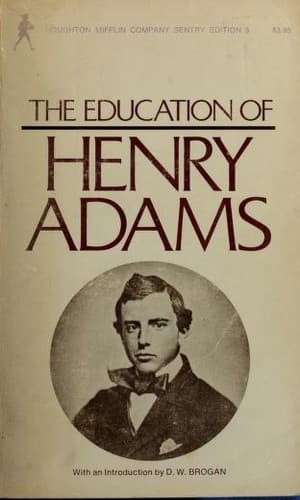
Adams, Henry, 1838-1918; Historians -- United States -- Biography
POLITICS, diplomacy, law, art, and history had opened no outlet
for future energy or effort, but a man must do something, even in
Portland Place, when winter is dark and winter evenings are exceedingly
long. At that moment Darwin was convulsing society. The geological
champion of Darwin was Sir Charles Lyell, and the Lyells were intimate
at the Legation. Sir Charles constantly said of Darwin, what Palgrave
said of Tennyson, that the first time he came to town, Adams should be
asked to meet him, but neither of them ever came to town, or ever cared
to meet a young American, and one could not go to them because they
were known to dislike intrusion. The only Americans who were not
allowed to intrude were the half-dozen in the Legation. Adams was
content to read Darwin, especially his "Origin of Species" and his
"Voyage of the Beagle." He was a Darwinist before the letter; a
predestined follower of the tide; but he was hardly trained to follow
Darwin's evidences. Fragmentary the British mind might be, but in those
days it was doing a great deal of work in a very un-English way,
building up so many and such vast theories on such narrow foundations
as to shock the conservative, and delight the frivolous. The atomic
theory; the correlation and conservation of energy; the mechanical
theory of the universe; the kinetic theory of gases, and Darwin's Law
of Natural Selection, were examples of what a young man had to take on
trust. Neither he nor any one else knew enough to verify them; in his
ignorance of mathematics, he was particularly helpless; but this never
stood in his way. The ideas were new and seemed to lead somewhere--to
some great generalization which would finish one's clamor to be
educated. That a beginner should understand them all, or believe them
all, no one could expect, still less exact. Henry Adams was Darwinist
because it was easier than not, for his ignorance exceeded belief, and
one must know something in order to contradict even such triflers as
Tyndall and Huxley.
By rights, he should have been also a Marxist but some narrow
trait of the New England nature seemed to blight socialism, and he
tried in vain to make himself a convert. He did the next best thing; he
became a Comteist, within the limits of evolution. He was ready to
become anything but quiet. As though the world had not been enough
upset in his time, he was eager to see it upset more. He had his wish,
but he lost his hold on the results by trying to understand them.
Public-domain text, read in full here on John Shaqi.
Reviews
Reviews
No reviews yet
Be the first to share your thoughts on this work.
Elsewhere in the archive
Join the Discussion
Join the discussion
Sign in to leave a comment or review.
Sign InorCreate an account