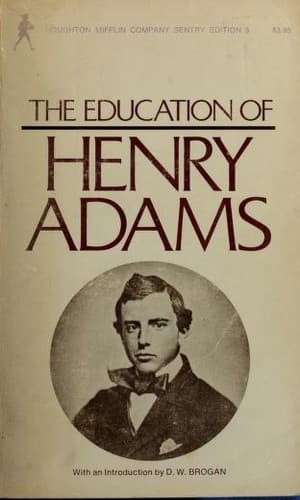
Adams, Henry, 1838-1918; Historians -- United States -- Biography
He never tried to understand Darwin; but he still fancied he
might get the best part of Darwinism from the easier study of geology;
a science which suited idle minds as well as though it were history.
Every curate in England dabbled in geology and hunted for vestiges of
Creation. Darwin hunted only for vestiges of Natural Selection, and
Adams followed him, although he cared nothing about Selection, unless
perhaps for the indirect amusement of upsetting curates. He felt, like
nine men in ten, an instinctive belief in Evolution, but he felt no
more concern in Natural than in unnatural Selection, though he seized
with greediness the new volume on the "Antiquity of Man" which Sir
Charles Lyell published in 1863 in order to support Darwin by wrecking
the Garden of Eden. Sir Charles next brought out, in 1866, a new
edition of his "Principles," then the highest text-book of geology; but
here the Darwinian doctrine grew in stature. Natural Selection led back
to Natural Evolution, and at last to Natural Uniformity. This was a
vast stride. Unbroken Evolution under uniform conditions pleased every
one--except curates and bishops; it was the very best substitute for
religion; a safe, conservative, practical, thoroughly Common-Law deity.
Such a working system for the universe suited a young man who had just
helped to waste five or ten thousand million dollars and a million
lives, more or less, to enforce unity and uniformity on people who
objected to it; the idea was only too seductive in its perfection; it
had the charm of art. Unity and Uniformity were the whole motive of
philosophy, and if Darwin, like a true Englishman, preferred to back
into it--to reach God a posteriori--rather than start from it, like
Spinoza, the difference of method taught only the moral that the best
way of reaching unity was to unite. Any road was good that arrived.
Life depended on it. One had been, from the first, dragged hither and
thither like a French poodle on a string, following always the
strongest pull, between one form of unity or centralization and
another. The proof that one had acted wisely because of obeying the
primordial habit of nature flattered one's self-esteem. Steady,
uniform, unbroken evolution from lower to higher seemed easy. So, one
day when Sir Charles came to the Legation to inquire about getting his
"Principles" properly noticed in America, young Adams found nothing
simpler than to suggest that he could do it himself if Sir Charles
would tell him what to say. Youth risks such encounters with the
universe before one succumbs to it, yet even he was surprised at Sir
Charles's ready assent, and still more so at finding himself, after
half an hour's conversation, sitting down to clear the minds of
American geologists about the principles of their profession. This was
getting on fast; Arthur Pendennis had never gone so far.
Public-domain text, read in full here on John Shaqi.
Reviews
Reviews
No reviews yet
Be the first to share your thoughts on this work.
Elsewhere in the archive
Join the Discussion
Join the discussion
Sign in to leave a comment or review.
Sign InorCreate an account