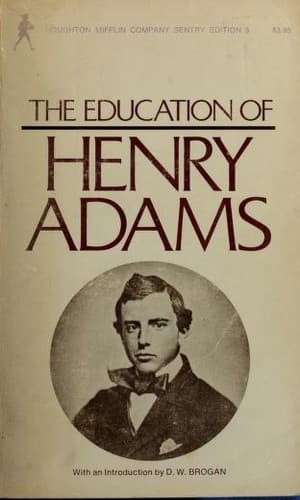
Adams, Henry, 1838-1918; Historians -- United States -- Biography
The geologists were a hardy class, not likely to be much hurt
by Adams's learning, nor did he throw away much concern on their
account. He undertook the task chiefly to educate, not them, but
himself, and if Sir Isaac Newton had, like Sir Charles Lyell, asked him
to explain for Americans his last edition of the "Principia," Adams
would have jumped at the chance. Unfortunately the mere reading such
works for amusement is quite a different matter from studying them for
criticism. Ignorance must always begin at the beginning. Adams must
inevitably have begun by asking Sir Isaac for an intelligible reason
why the apple fell to the ground. He did not know enough to be
satisfied with the fact. The Law of Gravitation was so-and-so, but what
was Gravitation? and he would have been thrown quite off his base if
Sir Isaac had answered that he did not know.
At the very outset Adams struck on Sir Charles's Glacial Theory
or theories. He was ignorant enough to think that the glacial epoch
looked like a chasm between him and a uniformitarian world. If the
glacial period were uniformity, what was catastrophe? To him the two or
three labored guesses that Sir Charles suggested or borrowed to explain
glaciation were proof of nothing, and were quite unsolid as support for
so immense a superstructure as geological uniformity. If one were at
liberty to be as lax in science as in theology, and to assume unity
from the start, one might better say so, as the Church did, and not
invite attack by appearing weak in evidence. Naturally a young man,
altogether ignorant, could not say this to Sir Charles Lyell or Sir
Isaac Newton; but he was forced to state Sir Charles's views, which he
thought weak as hypotheses and worthless as proofs. Sir Charles himself
seemed shy of them. Adams hinted his heresies in vain. At last he
resorted to what he thought the bold experiment of inserting a sentence
in the text, intended to provoke correction. "The introduction [by
Louis Agassiz] of this new geological agent seemed at first sight
inconsistent with Sir Charles's argument, obliging him to allow that
causes had in fact existed on the earth capable of producing more
violent geological changes than would be possible in our own day." The
hint produced no effect. Sir Charles said not a word; he let the
paragraph stand; and Adams never knew whether the great Uniformitarian
was strict or lax in his uniformitarian creed; but he doubted.
Public-domain text, read in full here on John Shaqi.
Reviews
Reviews
No reviews yet
Be the first to share your thoughts on this work.
Elsewhere in the archive
Join the Discussion
Join the discussion
Sign in to leave a comment or review.
Sign InorCreate an account