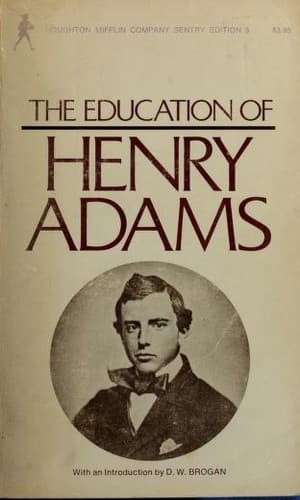
Adams, Henry, 1838-1918; Historians -- United States -- Biography
Objections fatal to one mind are futile to another, and as far
as concerned the article, the matter ended there, although the glacial
epoch remained a misty region in the young man's Darwinism. Had it been
the only one, he would not have fretted about it; but uniformity often
worked queerly and sometimes did not work as Natural Selection at all.
Finding himself at a loss for some single figure to illustrate the Law
of Natural Selection, Adams asked Sir Charles for the simplest case of
uniformity on record. Much to his surprise Sir Charles told him that
certain forms, like Terebratula, appeared to be identical from the
beginning to the end of geological time. Since this was altogether too
much uniformity and much too little selection, Adams gave up the
attempt to begin at the beginning, and tried starting at the
end--himself. Taking for granted that the vertebrates would serve his
purpose, he asked Sir Charles to introduce him to the first vertebrate.
Infinitely to his bewilderment, Sir Charles informed him that the first
vertebrate was a very respectable fish, among the earliest of all
fossils, which had lived, and whose bones were still reposing, under
Adams's own favorite Abbey on Wenlock Edge.
By this time, in 1867 Adams had learned to know Shropshire
familiarly, and it was the part of his diplomatic education which he
loved best. Like Catherine Olney in "Northanger Abbey," he yearned for
nothing so keenly as to feel at home in a thirteenth-century Abbey,
unless it were to haunt a fifteenth-century Prior's House, and both
these joys were his at Wenlock. With companions or without, he never
tired of it. Whether he rode about the Wrekin, or visited all the
historical haunts from Ludlow Castle and Stokesay to Boscobel and
Uriconium; or followed the Roman road or scratched in the Abbey ruins,
all was amusing and carried a flavor of its own like that of the Roman
Campagna; but perhaps he liked best to ramble over the Edge on a summer
afternoon and look across the Marches to the mountains of Wales. The
peculiar flavor of the scenery has something to do with absence of
evolution; it was better marked in Egypt: it was felt wherever
time-sequences became interchangeable. One's instinct abhors time. As
one lay on the slope of the Edge, looking sleepily through the summer
haze towards Shrewsbury or Cader Idris or Caer Caradoc or Uriconium,
nothing suggested sequence. The Roman road was twin to the railroad;
Uriconium was well worth Shrewsbury; Wenlock and Buildwas were far
superior to Bridgnorth. The shepherds of Caractacus or Offa, or the
monks of Buildwas, had they approached where he lay in the grass, would
have taken him only for another and tamer variety of Welsh thief. They
would have seen little to surprise them in the modern landscape unless
it were the steam of a distant railway. One might mix up the terms of
time as one liked, or stuff the present anywhere into the past,
Public-domain text, read in full here on John Shaqi.
Reviews
Reviews
No reviews yet
Be the first to share your thoughts on this work.
Elsewhere in the archive
Join the Discussion
Join the discussion
Sign in to leave a comment or review.
Sign InorCreate an account