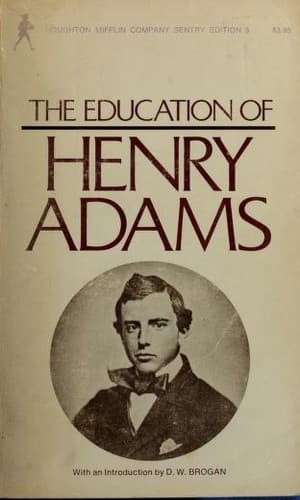
Adams, Henry, 1838-1918; Historians -- United States -- Biography
measuring time by Falstaff's Shrewsbury clock, without violent sense of
wrong, as one could do it on the Pacific Ocean; but the triumph of all
was to look south along the Edge to the abode of one's earliest
ancestor and nearest relative, the ganoid fish, whose name, according
to Professor Huxley, was Pteraspis, a cousin of the sturgeon, and whose
kingdom, according to Sir Roderick Murchison, was called Siluria. Life
began and ended there. Behind that horizon lay only the Cambrian,
without vertebrates or any other organism except a few shell-fish. On
the further verge of the Cambrian rose the crystalline rocks from which
every trace of organic existence had been erased.
That here, on the Wenlock Edge of time, a young American,
seeking only frivolous amusement, should find a legitimate parentage as
modern as though just caught in the Severn below, astonished him as
much as though he had found Darwin himself. In the scale of evolution,
one vertebrate was as good as another. For anything he, or any one
else, knew, nine hundred and ninety nine parts of evolution out of a
thousand lay behind or below the Pteraspis. To an American in search of
a father, it mattered nothing whether the father breathed through
lungs, or walked on fins, or on feet. Evolution of mind was altogether
another matter and belonged to another science, but whether one traced
descent from the shark or the wolf was immaterial even in morals. This
matter had been discussed for ages without scientific result. La
Fontaine and other fabulists maintained that the wolf, even in morals,
stood higher than man; and in view of the late civil war, Adams had
doubts of his own on the facts of moral evolution:--
"Tout bien considere, je te soutiens en somme,
Que scelerat pour scelerat,
Il vaut mieux etre un loup qu'un homme."
It might well be! At all events, it did not enter into the
problem of Pteraspis, for it was quite certain that no complete proof
of Natural Selection had occurred back to the time of Pteraspis, and
that before Pteraspis was eternal void. No trace of any vertebrate had
been found there; only starfish, shell-fish, polyps, or trilobites
whose kindly descendants he had often bathed with, as a child on the
shores of Quincy Bay.
Public-domain text, read in full here on John Shaqi.
Reviews
Reviews
No reviews yet
Be the first to share your thoughts on this work.
Elsewhere in the archive
Join the Discussion
Join the discussion
Sign in to leave a comment or review.
Sign InorCreate an account