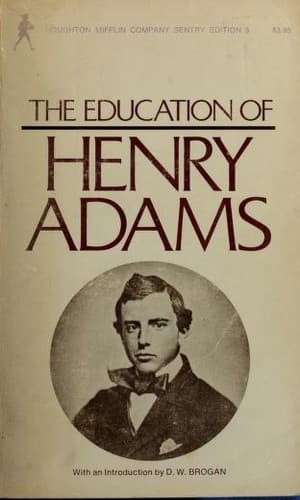
Adams, Henry, 1838-1918; Historians -- United States -- Biography
That Pteraspis and shark were his cousins, great-uncles, or
grandfathers, in no way troubled him, but that either or both of them
should be older than evolution itself seemed to him perplexing; nor
could he at all simplify the problem by taking the sudden
back-somersault into Quincy Bay in search of the fascinating creature
he had called a horseshoe, whose huge dome of shell and sharp spur of
tail had so alarmed him as a child. In Siluria, he understood, Sir
Roderick Murchison called the horseshoe a Limulus, which helped
nothing. Neither in the Limulus nor in the Terebratula, nor in the
Cestracion Philippi, any more than in the Pteraspis, could one
conceive an ancestor, but, if one must, the choice mattered little.
Cousinship had limits but no one knew enough to fix them. When the
vertebrate vanished in Siluria, it disappeared instantly and forever.
Neither vertebra nor scale nor print reappeared, nor any trace of
ascent or descent to a lower type. The vertebrate began in the Ludlow
shale, as complete as Adams himself--in some respects more so--at the
top of the column of organic evolution: and geology offered no sort of
proof that he had ever been anything else. Ponder over it as he might,
Adams could see nothing in the theory of Sir Charles but pure
inference, precisely like the inference of Paley, that, if one found a
watch, one inferred a maker. He could detect no more evolution in life
since the Pteraspis than he could detect it in architecture since the
Abbey. All he could prove was change. Coal-power alone asserted
evolution--of power--and only by violence could be forced to assert
selection of type.
All this seemed trivial to the true Darwinian, and to Sir
Charles it was mere defect in the geological record. Sir Charles
labored only to heap up the evidences of evolution; to cumulate them
till the mass became irresistible. With that purpose, Adams gladly
studied and tried to help Sir Charles, but, behind the lesson of the
day, he was conscious that, in geology as in theology, he could prove
only Evolution that did not evolve; Uniformity that was not uniform;
and Selection that did not select. To other Darwinians--except
Darwin--Natural Selection seemed a dogma to be put in the place of the
Athanasian creed; it was a form of religious hope; a promise of
ultimate perfection. Adams wished no better; he warmly sympathized in
the object; but when he came to ask himself what he truly thought, he
felt that he had no Faith; that whenever the next new hobby should be
brought out, he should surely drop off from Darwinism like a monkey
from a perch; that the idea of one Form, Law, Order, or Sequence had no
more value for him than the idea of none; that what he valued most was
Motion, and that what attracted his mind was Change.
Public-domain text, read in full here on John Shaqi.
Reviews
Reviews
No reviews yet
Be the first to share your thoughts on this work.
Elsewhere in the archive
Join the Discussion
Join the discussion
Sign in to leave a comment or review.
Sign InorCreate an account