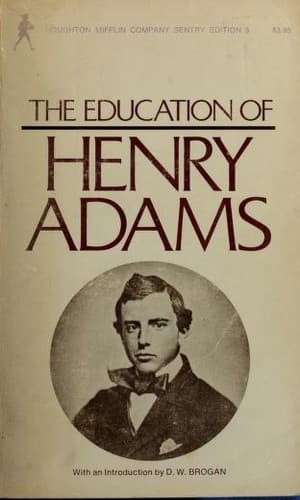
Adams, Henry, 1838-1918; Historians -- United States -- Biography
Psychology was to him a new study, and a dark corner of
education. As he lay on Wenlock Edge, with the sheep nibbling the grass
close about him as they or their betters had nibbled the grass--or
whatever there was to nibble--in the Silurian kingdom of Pteraspis, he
seemed to have fallen on an evolution far more wonderful than that of
fishes. He did not like it; he could not account for it; and he
determined to stop it. Never since the days of his Limulus ancestry had
any of his ascendants thought thus. Their modes of thought might be
many, but their thought was one. Out of his millions of millions of
ancestors, back to the Cambrian mollusks, every one had probably lived
and died in the illusion of Truths which did not amuse him, and which
had never changed. Henry Adams was the first in an infinite series to
discover and admit to himself that he really did not care whether truth
was, or was not, true. He did not even care that it should be proved
true, unless the process were new and amusing. He was a Darwinian for
fun.
From the beginning of history, this attitude had been branded
as criminal--worse than crime--sacrilege! Society punished it
ferociously and justly, in self-defence. Mr. Adams, the father, looked
on it as moral weakness; it annoyed him; but it did not annoy him
nearly so much as it annoyed his son, who had no need to learn from
Hamlet the fatal effect of the pale cast of thought on enterprises
great or small. He had no notion of letting the currents of his action
be turned awry by this form of conscience. To him, the current of his
time was to be his current, lead where it might. He put psychology
under lock and key; he insisted on maintaining his absolute standards;
on aiming at ultimate Unity. The mania for handling all the sides of
every question, looking into every window, and opening every door, was,
as Bluebeard judiciously pointed out to his wives, fatal to their
practical usefulness in society. One could not stop to chase doubts as
though they were rabbits. One had no time to paint and putty the
surface of Law, even though it were cracked and rotten. For the young
men whose lives were cast in the generation between 1867 and 1900, Law
should be Evolution from lower to higher, aggregation of the atom in
the mass, concentration of multiplicity in unity, compulsion of anarchy
in order; and he would force himself to follow wherever it led, though
he should sacrifice five thousand millions more in money, and a million
more lives.
As the path ultimately led, it sacrificed much more than this;
but at the time, he thought the price he named a high one, and he could
not foresee that science and society would desert him in paying it. He,
at least, took his education as a Darwinian in good faith. The Church
was gone, and Duty was dim, but Will should take its place, founded
deeply in interest and law. This was the result of five or six years in
England; a result so British as to be almost the equivalent of an
Oxford degree.
Public-domain text, read in full here on John Shaqi.
Reviews
Reviews
No reviews yet
Be the first to share your thoughts on this work.
Elsewhere in the archive
Join the Discussion
Join the discussion
Sign in to leave a comment or review.
Sign InorCreate an account