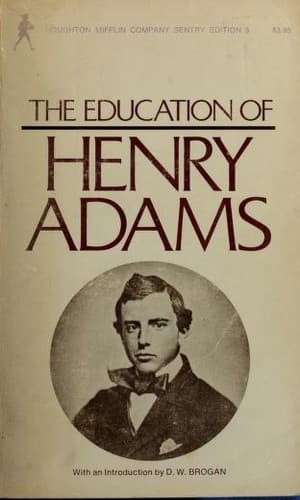
Adams, Henry, 1838-1918; Historians -- United States -- Biography
Quite serious about it, he set to work at once. While confusing
his ideas about geology to the apparent satisfaction of Sir Charles who
left him his field-compass in token of it, Adams turned resolutely to
business, and attacked the burning question of specie payments. His
principles assured him that the honest way to resume payments was to
restrict currency. He thought he might win a name among financiers and
statesmen at home by showing how this task had been done by England,
after the classical suspension of 1797-1821. Setting himself to the
study of this perplexed period, he waded as well as he could through a
morass of volumes, pamphlets, and debates, until he learned to his
confusion that the Bank of England itself and all the best British
financial writers held that restriction was a fatal mistake, and that
the best treatment of a debased currency was to let it alone, as the
Bank had in fact done. Time and patience were the remedies.
The shock of this discovery to his financial principles was
serious; much more serious than the shock of the Terebratula and
Pteraspis to his principles of geology. A mistake about Evolution was
not fatal; a mistake about specie payments would destroy forever the
last hope of employment in State Street. Six months of patient labor
would be thrown away if he did not publish, and with it his whole
scheme of making himself a position as a practical man-of-business. If
he did publish, how could he tell virtuous bankers in State Street that
moral and absolute principles of abstract truth, such as theirs, had
nothing to do with the matter, and that they had better let it alone?
Geologists, naturally a humble and helpless class, might not revenge
impertinences offered to their science; but capitalists never forgot or
forgave.
With labor and caution he made one long article on British
Finance in 1816, and another on the Bank Restriction of 1797-1821, and,
doing both up in one package, he sent it to the North American for
choice. He knew that two heavy, technical, financial studies thus
thrown at an editor's head, would probably return to crush the author;
but the audacity of youth is more sympathetic--when successful--than
his ignorance. The editor accepted both.
Public-domain text, read in full here on John Shaqi.
Reviews
Reviews
No reviews yet
Be the first to share your thoughts on this work.
Elsewhere in the archive
Join the Discussion
Join the discussion
Sign in to leave a comment or review.
Sign InorCreate an account