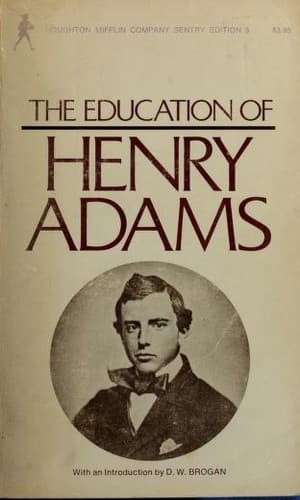
Adams, Henry, 1838-1918; Historians -- United States -- Biography
When the post brought his letter, Adams looked at it as though
he were a debtor who had begged for an extension. He read it with as
much relief as the debtor, if it had brought him the loan. The letter
gave the new writer literary rank. Henceforward he had the freedom of
the press. These articles, following those on Pocahontas and Lyell,
enrolled him on the permanent staff of the North American Review.
Precisely what this rank was worth, no one could say; but, for fifty
years the North American Review had been the stage coach which carried
literary Bostonians to such distinction as they had achieved. Few
writers had ideas which warranted thirty pages of development, but for
such as thought they had, the Review alone offered space. An article
was a small volume which required at least three months' work, and was
paid, at best, five dollars a page. Not many men even in England or
France could write a good thirty-page article, and practically no one
in America read them; but a few score of people, mostly in search of
items to steal, ran over the pages to extract an idea or a fact, which
was a sort of wild game--a bluefish or a teal--worth anywhere from
fifty cents to five dollars. Newspaper writers had their eye on
quarterly pickings. The circulation of the Review had never exceeded
three or four hundred copies, and the Review had never paid its
reasonable expenses. Yet it stood at the head of American literary
periodicals; it was a source of suggestion to cheaper workers; it
reached far into societies that never knew its existence; it was an
organ worth playing on; and, in the fancy of Henry Adams, it led, in
some indistinct future, to playing on a New York daily newspaper.
With the editor's letter under his eyes, Adams asked himself
what better he could have done. On the whole, considering his
helplessness, he thought he had done as well as his neighbors. No one
could yet guess which of his contemporaries was most likely to play a
part in the great world. A shrewd prophet in Wall Street might perhaps
have set a mark on Pierpont Morgan, but hardly on the Rockefellers or
William C. Whitney or Whitelaw Reid. No one would have picked out
William McKinley or John Hay or Mark Hanna for great statesmen. Boston
was ignorant of the careers in store for Alexander Agassiz and Henry
Higginson. Phillips Brooks was unknown; Henry James was unheard;
Howells was new; Richardson and LaFarge were struggling for a start.
Out of any score of names and reputations that should reach beyond the
century, the thirty-years-old who were starting in the year 1867 could
show none that was so far in advance as to warrant odds in its favor.
The army men had for the most part fallen to the ranks. Had Adams
foreseen the future exactly as it came, he would have been no wiser,
and could have chosen no better path.
Public-domain text, read in full here on John Shaqi.
Reviews
Reviews
No reviews yet
Be the first to share your thoughts on this work.
Elsewhere in the archive
Join the Discussion
Join the discussion
Sign in to leave a comment or review.
Sign InorCreate an account