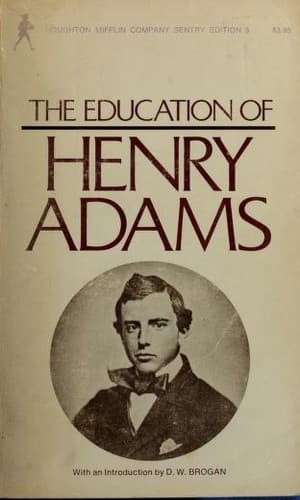
Adams, Henry, 1838-1918; Historians -- United States -- Biography
Thus it turned out that the last year in England was the
pleasantest. He was already old in society, and belonged to the
Silurian horizon. The Prince of Wales had come. Mr. Disraeli, Lord
Stanley, and the future Lord Salisbury had thrown into the background
the memories of Palmerston and Russell. Europe was moving rapidly, and
the conduct of England during the American Civil War was the last thing
that London liked to recall. The revolution since 1861 was nearly
complete, and, for the first time in history, the American felt himself
almost as strong as an Englishman. He had thirty years to wait before
he should feel himself stronger. Meanwhile even a private secretary
could afford to be happy. His old education was finished; his new one
was not begun; he still loitered a year, feeling himself near the end
of a very long, anxious, tempestuous, successful voyage, with another
to follow, and a summer sea between.
He made what use he could of it. In February, 1868, he was back
in Rome with his friend Milnes Gaskell. For another season he wandered
on horseback over the campagna or on foot through the Rome of the
middle ages, and sat once more on the steps of Ara Coeli, as had become
with him almost a superstition, like the waters of the fountain of
Trevi. Rome was still tragic and solemn as ever, with its mediaeval
society, artistic, literary, and clerical, taking itself as seriously
as in the days of Byron and Shelley. The long ten years of accidental
education had changed nothing for him there. He knew no more in 1868
than in 1858. He had learned nothing whatever that made Rome more
intelligible to him, or made life easier to handle. The case was no
better when he got back to London and went through his last season.
London had become his vice. He loved his haunts, his houses, his
habits, and even his hansom cabs. He loved growling like an Englishman,
and going into society where he knew not a face, and cared not a straw.
He lived deep into the lives and loves and disappointments of his
friends. When at last he found himself back again at Liverpool, his
heart wrenched by the act of parting, he moved mechanically, unstrung,
but he had no more acquired education than when he first trod the steps
of the Adelphi Hotel in November, 1858. He could see only one great
change, and this was wholly in years. Eaton Hall no longer impressed
his imagination; even the architecture of Chester roused but a sleepy
interest; he felt no sensation whatever in the atmosphere of the
British peerage, but mainly an habitual dislike to most of the people
who frequented their country houses; he had become English to the point
of sharing their petty social divisions, their dislikes and prejudices
against each other; he took England no longer with the awe of American
youth, but with the habit of an old and rather worn suit of clothes. As
far as he knew, this was all that Englishmen meant by social education,
Public-domain text, read in full here on John Shaqi.
Reviews
Reviews
No reviews yet
Be the first to share your thoughts on this work.
Elsewhere in the archive
Join the Discussion
Join the discussion
Sign in to leave a comment or review.
Sign InorCreate an account