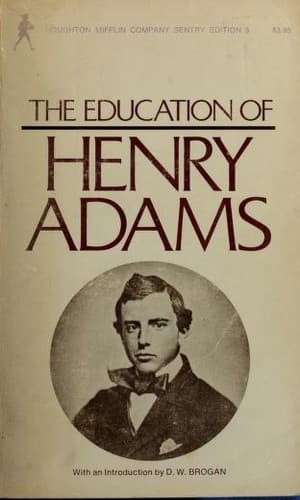
Adams, Henry, 1838-1918; Historians -- United States -- Biography
but in any case it was all the education he had gained from seven years
in London.
CHAPTER XVI
THE PRESS (1868)
AT ten o'clock of a July night, in heat that made the tropical
rain-shower simmer, the Adams family and the Motley family clambered
down the side of their Cunard steamer into the government tugboat,
which set them ashore in black darkness at the end of some North River
pier. Had they been Tyrian traders of the year B.C. 1000 landing from a
galley fresh from Gibraltar, they could hardly have been stranger on
the shore of a world, so changed from what it had been ten years
before. The historian of the Dutch, no longer historian but
diplomatist, started up an unknown street, in company with the private
secretary who had become private citizen, in search of carriages to
convey the two parties to the Brevoort House. The pursuit was arduous
but successful. Towards midnight they found shelter once more in their
native land.
How much its character had changed or was changing, they could
not wholly know, and they could but partly feel. For that matter, the
land itself knew no more than they. Society in America was always
trying, almost as blindly as an earthworm, to realize and understand
itself; to catch up with its own head, and to twist about in search of
its tail. Society offered the profile of a long, straggling caravan,
stretching loosely towards the prairies, its few score of leaders far
in advance and its millions of immigrants, negroes, and Indians far in
the rear, somewhere in archaic time. It enjoyed the vast advantage over
Europe that all seemed, for the moment, to move in one direction, while
Europe wasted most of its energy in trying several contradictory
movements at once; but whenever Europe or Asia should be polarized or
oriented towards the same point, America might easily lose her lead.
Meanwhile each newcomer needed to slip into a place as near the head of
the caravan as possible, and needed most to know where the leaders
could be found. One could divine pretty nearly where the force lay,
since the last ten years had given to the great mechanical
energies--coal, iron, steam--a distinct superiority in power over the
old industrial elements--agriculture, handwork, and learning; but the
result of this revolution on a survivor from the fifties resembled the
action of the earthworm; he twisted about, in vain, to recover his
starting-point; he could no longer see his own trail; he had become an
estray; a flotsam or jetsam of wreckage; a belated reveller, or a
scholar-gipsy like Matthew Arnold's. His world was dead. Not a Polish
Jew fresh from Warsaw or Cracow--not a furtive Yacoob or Ysaac still
reeking of the Ghetto, snarling a weird Yiddish to the officers of the
customs--but had a keener instinct, an intenser energy, and a freer
hand than he--American of Americans, with Heaven knew how many Puritans
and Patriots behind him, and an education that had cost a civil war. He
Public-domain text, read in full here on John Shaqi.
Reviews
Reviews
No reviews yet
Be the first to share your thoughts on this work.
Elsewhere in the archive
Join the Discussion
Join the discussion
Sign in to leave a comment or review.
Sign InorCreate an account