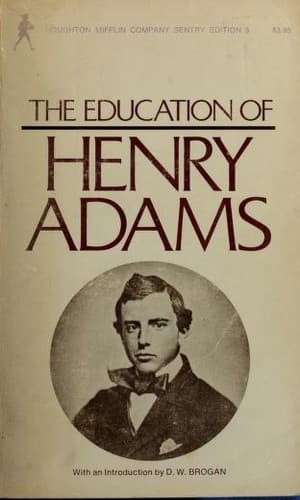
Adams, Henry, 1838-1918; Historians -- United States -- Biography
made no complaint and found no fault with his time; he was no worse off
than the Indians or the buffalo who had been ejected from their
heritage by his own people; but he vehemently insisted that he was not
himself at fault. The defeat was not due to him, nor yet to any
superiority of his rivals. He had been unfairly forced out of the
track, and must get back into it as best he could.
One comfort he could enjoy to the full. Little as he might be
fitted for the work that was before him, he had only to look at his
father and Motley to see figures less fitted for it than he. All were
equally survivals from the forties--bric-a-brac from the time of Louis
Philippe; stylists; doctrinaires; ornaments that had been more or less
suited to the colonial architecture, but which never had much value in
Desbrosses Street or Fifth Avenue. They could scarcely have earned five
dollars a day in any modern industry. The men who commanded high pay
were as a rule not ornamental. Even Commodore Vanderbilt and Jay Gould
lacked social charm. Doubtless the country needed ornament--needed it
very badly indeed--but it needed energy still more, and capital most of
all, for its supply was ridiculously out of proportion to its wants. On
the new scale of power, merely to make the continent habitable for
civilized people would require an immediate outlay that would have
bankrupted the world. As yet, no portion of the world except a few
narrow stretches of western Europe had ever been tolerably provided
with the essentials of comfort and convenience; to fit out an entire
continent with roads and the decencies of life would exhaust the credit
of the entire planet. Such an estimate seemed outrageous to a Texan
member of Congress who loved the simplicity of nature's noblemen; but
the mere suggestion that a sun existed above him would outrage the
self-respect of a deep-sea fish that carried a lantern on the end of
its nose. From the moment that railways were introduced, life took on
extravagance.
Thus the belated reveller who landed in the dark at the
Desbrosses Street ferry, found his energies exhausted in the effort to
see his own length. The new Americans, of whom he was to be one, must,
whether they were fit or unfit, create a world of their own, a science,
a society, a philosophy, a universe, where they had not yet created a
road or even learned to dig their own iron. They had no time for
thought; they saw, and could see, nothing beyond their day's work;
their attitude to the universe outside them was that of the deep-sea
fish. Above all, they naturally and intensely disliked to be told what
to do, and how to do it, by men who took their ideas and their methods
from the abstract theories of history, philosophy, or theology. They
knew enough to know that their world was one of energies quite new.
Public-domain text, read in full here on John Shaqi.
Reviews
Reviews
No reviews yet
Be the first to share your thoughts on this work.
Elsewhere in the archive
Join the Discussion
Join the discussion
Sign in to leave a comment or review.
Sign InorCreate an account