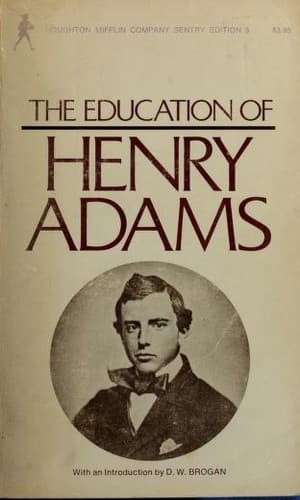
Adams, Henry, 1838-1918; Historians -- United States -- Biography
Chaos often breeds life, when order breeds habit. The Civil War
had bred life. The army bred courage. Young men of the volunteer type
were not always docile under control, but they were handy in a fight.
Adams was greatly pleased to be admitted as one of them. He found
himself much at home with them--more at home than he ever had been
before, or was ever to be again--in the atmosphere of the Treasury. He
had no strong party passion, and he felt as though he and his friends
owned this administration, which, in its dying days, had neither
friends nor future except in them.
These were not the only allies; the whole government in all its
branches was alive with them. Just at that moment the Supreme Court was
about to take up the Legal Tender cases where Judge Curtis had been
employed to argue against the constitutional power of the Government to
make an artificial standard of value in time of peace. Evarts was
anxious to fix on a line of argument that should have a chance of
standing up against that of Judge Curtis, and was puzzled to do it. He
did not know which foot to put forward. About to deal with Judge
Curtis, the last of the strong jurists of Marshall's school, he could
risk no chances. In doubt, the quickest way to clear one's mind is to
discuss, and Evarts deliberately forced discussion. Day after day,
driving, dining, walking he provoked Adams to dispute his positions. He
needed an anvil, he said, to hammer his ideas on.
Adams was flattered at being an anvil, which is, after all,
more solid than the hammer; and he did not feel called on to treat Mr.
Evarts's arguments with more respect than Mr. Evarts himself expressed
for them; so he contradicted with freedom. Like most young men, he was
much of a doctrinaire, and the question was, in any event, rather
historical or political than legal. He could easily maintain, by way of
argument, that the required power had never been given, and that no
sound constitutional reason could possibly exist for authorizing the
Government to overthrow the standard of value without necessity, in
time of peace. The dispute itself had not much value for him, even as
education, but it led to his seeking light from the Chief Justice
himself. Following up the subject for his letters to the Nation and his
articles in the North American Review, Adams grew to be intimate with
the Chief Justice, who, as one of the oldest and strongest leaders of
the Free Soil Party, had claims to his personal regard; for the old
Free Soilers were becoming few. Like all strong-willed and
self-asserting men, Mr. Chase had the faults of his qualities. He was
never easy to drive in harness, or light in hand. He saw vividly what
was wrong, and did not always allow for what was relatively right. He
loved power as though he were still a Senator. His position towards
Legal Tender was awkward. As Secretary of the Treasury he had been its
author; as Chief Justice he became its enemy. Legal Tender caused no
Public-domain text, read in full here on John Shaqi.
Reviews
Reviews
No reviews yet
Be the first to share your thoughts on this work.
Elsewhere in the archive
Join the Discussion
Join the discussion
Sign in to leave a comment or review.
Sign InorCreate an account