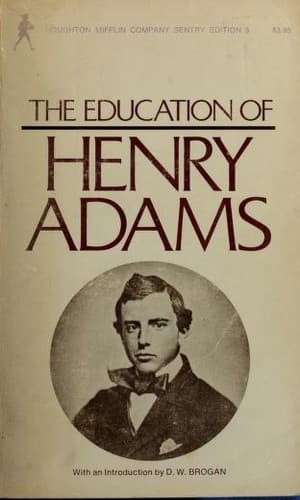
Adams, Henry, 1838-1918; Historians -- United States -- Biography
None of Adams's generation profited by public activity unless
it were William C. Whitney, and even he could not be induced to return
to it. Such ambitions as these were out of one's reach, but supposing
one tried for what was feasible, attached one's self closely to the
Garfields, Arthurs, Frelinghuysens, Blaines, Bayards, or Whitneys, who
happened to hold office; and supposing one asked for the mission to
Belgium or Portugal, and obtained it; supposing one served a term as
Assistant Secretary or Chief of Bureau; or, finally, supposing one had
gone as sub-editor on the New York Tribune or Times--how much more
education would one have gained than by going to Harvard College? These
questions seemed better worth an answer than most of the questions on
examination papers at college or in the civil service; all the more
because one never found an answer to them, then or afterwards, and
because, to his mind, the value of American society altogether was
mixed up with the value of Washington.
At first, the simple beginner, struggling with principles,
wanted to throw off responsibility on the American people, whose bare and
toiling shoulders had to carry the load of every social or political
stupidity; but the American people had no more to do with it than with
the customs of Peking. American character might perhaps account for it,
but what accounted for American character? All Boston, all New England,
and all respectable New York, including Charles Francis Adams the
father and Charles Francis Adams the son, agreed that Washington was no
place for a respectable young man. All Washington, including
Presidents, Cabinet officers, Judiciary, Senators, Congressmen, and
clerks, expressed the same opinion, and conspired to drive away every
young man who happened to be there or tried to approach. Not one young
man of promise remained in the Government service. All drifted into
opposition. The Government did not want them in Washington. Adams's
case was perhaps the strongest because he thought he had done well. He
was forced to guess it, since he knew no one who would have risked so
extravagant a step as that of encouraging a young man in a literary
career, or even in a political one; society forbade it, as well as
residence in a political capital; but Harvard College must have seen
some hope for him, since it made him professor against his will; even
the publishers and editors of the North American Review must have felt
a certain amount of confidence in him, since they put the Review in his
hands. After all, the Review was the first literary power in America,
even though it paid almost as little in gold as the United States
Treasury. The degree of Harvard College might bear a value as ephemeral
as the commission of a President of the United States; but the
government of the college, measured by money alone, and patronage, was
a matter of more importance than that of some branches of the national
service.
Public-domain text, read in full here on John Shaqi.
Reviews
Reviews
No reviews yet
Be the first to share your thoughts on this work.
Elsewhere in the archive
Join the Discussion
Join the discussion
Sign in to leave a comment or review.
Sign InorCreate an account