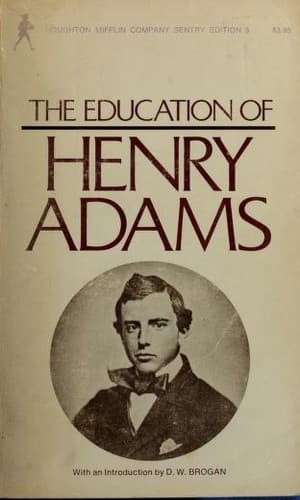
Adams, Henry, 1838-1918; Historians -- United States -- Biography
In social position, the college was the superior of them all
put together. In knowledge, she could assert no superiority, since the
Government made no claims, and prided itself on ignorance. The service
of Harvard College was distinctly honorable; perhaps the most honorable
in America; and if Harvard College thought Henry Adams worth employing
at four dollars a day, why should Washington decline his services when
he asked nothing? Why should he be dragged from a career he liked in a
place he loved, into a career he detested, in a place and climate he
shunned? Was it enough to satisfy him, that all America should call
Washington barren and dangerous? What made Washington more dangerous
than New York?
The American character showed singular limitations which
sometimes drove the student of civilized man to despair. Crushed by his
own ignorance--lost in the darkness of his own gropings--the scholar
finds himself jostled of a sudden by a crowd of men who seem to him
ignorant that there is a thing called ignorance; who have forgotten how
to amuse themselves; who cannot even understand that they are bored.
The American thought of himself as a restless, pushing, energetic,
ingenious person, always awake and trying to get ahead of his
neighbors. Perhaps this idea of the national character might be correct
for New York or Chicago; it was not correct for Washington. There the
American showed himself, four times in five, as a quiet, peaceful, shy
figure, rather in the mould of Abraham Lincoln, somewhat sad, sometimes
pathetic, once tragic; or like Grant, inarticulate, uncertain,
distrustful of himself, still more distrustful of others, and awed by
money. That the American, by temperament, worked to excess, was true;
work and whiskey were his stimulants; work was a form of vice; but he
never cared much for money or power after he earned them. The amusement
of the pursuit was all the amusement he got from it; he had no use for
wealth. Jim Fisk alone seemed to know what he wanted; Jay Gould never
did. At Washington one met mostly such true Americans, but if one
wanted to know them better, one went to study them in Europe. Bored,
patient, helpless; pathetically dependent on his wife and daughters;
indulgent to excess; mostly a modest, decent, excellent, valuable
citizen; the American was to be met at every railway station in Europe,
carefully explaining to every listener that the happiest day of his
life would be the day he should land on the pier at New York. He was
ashamed to be amused; his mind no longer answered to the stimulus of
variety; he could not face a new thought. All his immense strength, his
intense nervous energy, his keen analytic perceptions, were oriented in
one direction, and he could not change it. Congress was full of such
men; in the Senate, Sumner was almost the only exception; in the
Executive, Grant and Boutwell were varieties of the type--political
specimens--pathetic in their helplessness to do anything with power
Public-domain text, read in full here on John Shaqi.
Reviews
Reviews
No reviews yet
Be the first to share your thoughts on this work.
Elsewhere in the archive
Join the Discussion
Join the discussion
Sign in to leave a comment or review.
Sign InorCreate an account