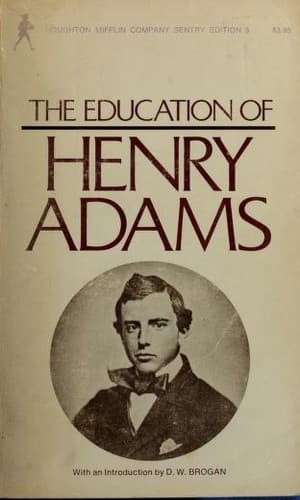
Adams, Henry, 1838-1918; Historians -- United States -- Biography
when it came to them. They knew not how to amuse themselves; they could
not conceive how other people were amused. Work, whiskey, and cards
were life. The atmosphere of political Washington was theirs--or was
supposed by the outside world to be in their control--and this was the
reason why the outside world judged that Washington was fatal even for
a young man of thirty-two, who had passed through the whole variety of
temptations, in every capital of Europe, for a dozen years; who never
played cards, and who loathed whiskey.
CHAPTER XX
FAILURE (1871)
FAR back in childhood, among its earliest memories, Henry Adams could
recall his first visit to Harvard College. He must have been nine years
old when on one of the singularly gloomy winter afternoons which
beguiled Cambridgeport, his mother drove him out to visit his aunt,
Mrs. Everett. Edward Everett was then President of the college and
lived in the old President's House on Harvard Square. The boy
remembered the drawing-room, on the left of the hall door, in which
Mrs. Everett received them. He remembered a marble greyhound in the
corner. The house had an air of colonial self-respect that impressed
even a nine-year-old child.
When Adams closed his interview with President Eliot, he asked
the Bursar about his aunt's old drawing-room, for the house had been
turned to base uses. The room and the deserted kitchen adjacent to it
were to let. He took them. Above him, his brother Brooks, then a law
student, had rooms, with a private staircase. Opposite was J. R.
Dennett, a young instructor almost as literary as Adams himself, and
more rebellious to conventions. Inquiry revealed a boarding-table,
somewhere in the neighborhood, also supposed to be superior in its
class. Chauncey Wright, Francis Wharton, Dennett, John Fiske, or their
equivalents in learning and lecture, were seen there, among three or
four law students like Brooks Adams. With these primitive arrangements,
all of them had to be satisfied. The standard was below that of
Washington, but it was, for the moment, the best.
For the next nine months the Assistant Professor had no time to
waste on comforts or amusements. He exhausted all his strength in
trying to keep one day ahead of his duties. Often the stint ran on,
till night and sleep ran short. He could not stop to think whether he
were doing the work rightly. He could not get it done to please him,
rightly or wrongly, for he never could satisfy himself what to do.
Public-domain text, read in full here on John Shaqi.
Reviews
Reviews
No reviews yet
Be the first to share your thoughts on this work.
Elsewhere in the archive
Join the Discussion
Join the discussion
Sign in to leave a comment or review.
Sign InorCreate an account