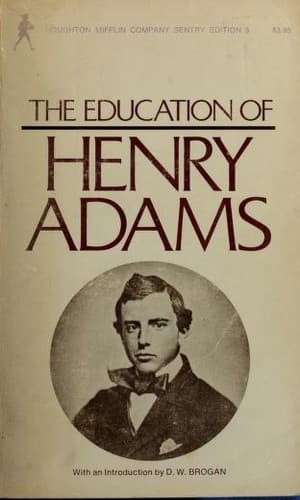
Adams, Henry, 1838-1918; Historians -- United States -- Biography
The fault he had found with Harvard College as an undergraduate
must have been more or less just, for the college was making a great
effort to meet these self-criticisms, and had elected President Eliot
in 1869 to carry out its reforms. Professor Gurney was one of the
leading reformers, and had tried his hand on his own department of
History. The two full Professors of History--Torrey and Gurney,
charming men both--could not cover the ground. Between Gurney's
classical courses and Torrey's modern ones, lay a gap of a thousand
years, which Adams was expected to fill. The students had already
elected courses numbered 1, 2, and 3, without knowing what was to be
taught or who was to teach. If their new professor had asked what idea
was in their minds, they must have replied that nothing at all was in
their minds, since their professor had nothing in his, and down to the
moment he took his chair and looked his scholars in the face, he had
given, as far as he could remember, an hour, more or less, to the
Middle Ages.
Not that his ignorance troubled him! He knew enough to be
ignorant. His course had led him through oceans of ignorance; he had
tumbled from one ocean into another till he had learned to swim; but
even to him education was a serious thing. A parent gives life, but as
parent, gives no more. A murderer takes life, but his deed stops there.
A teacher affects eternity; he can never tell where his influence
stops. A teacher is expected to teach truth, and may perhaps flatter
himself that he does so, if he stops with the alphabet or the
multiplication table, as a mother teaches truth by making her child eat
with a spoon; but morals are quite another truth and philosophy is more
complex still. A teacher must either treat history as a catalogue, a
record, a romance, or as an evolution; and whether he affirms or denies
evolution, he falls into all the burning faggots of the pit. He makes
of his scholars either priests or atheists, plutocrats or socialists,
judges or anarchists, almost in spite of himself. In essence incoherent
and immoral, history had either to be taught as such--or falsified.
Public-domain text, read in full here on John Shaqi.
Reviews
Reviews
No reviews yet
Be the first to share your thoughts on this work.
Elsewhere in the archive
Join the Discussion
Join the discussion
Sign in to leave a comment or review.
Sign InorCreate an account