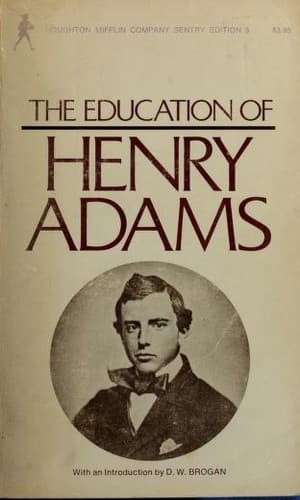
Adams, Henry, 1838-1918; Historians -- United States -- Biography
Adams wanted to do neither. He had no theory of evolution to
teach, and could not make the facts fit one. He had no fancy for
telling agreeable tales to amuse sluggish-minded boys, in order to
publish them afterwards as lectures. He could still less compel his
students to learn the Anglo-Saxon Chronicle and the Venerable Bede by
heart. He saw no relation whatever between his students and the Middle
Ages unless it were the Church, and there the ground was particularly
dangerous. He knew better than though he were a professional historian
that the man who should solve the riddle of the Middle Ages and bring
them into the line of evolution from past to present, would be a
greater man than Lamarck or Linnaeus; but history had nowhere broken
down so pitiably, or avowed itself so hopelessly bankrupt, as there.
Since Gibbon, the spectacle was almost a scandal. History had lost even
the sense of shame. It was a hundred years behind the experimental
sciences. For all serious purpose, it was less instructive than Walter
Scott and Alexandre Dumas.
All this was without offence to Sir Henry Maine, Tyler,
McLennan, Buckle, Auguste Comte, and the various philosophers who, from
time to time, stirred the scandal, and made it more scandalous. No
doubt, a teacher might make some use of these writers or their
theories; but Adams could fit them into no theory of his own. The
college expected him to pass at least half his time teaching the boys a
few elementary dates and relations, that they might not be a disgrace
to the university. This was formal; and he could frankly tell the boys
that, provided they passed their examinations, they might get their
facts where they liked, and use the teacher only for questions. The
only privilege a student had that was worth his claiming, was that of
talking to the professor, and the professor was bound to encourage it.
His only difficulty on that side was to get them to talk at all. He had
to devise schemes to find what they were thinking about, and induce
them to risk criticism from their fellows. Any large body of students
stifles the student. No man can instruct more than half-a-dozen
students at once. The whole problem of education is one of its cost in
money.
The lecture system to classes of hundreds, which was very much
that of the twelfth century, suited Adams not at all. Barred from
philosophy and bored by facts, he wanted to teach his students
something not wholly useless. The number of students whose minds were
of an order above the average was, in his experience, barely one in
ten; the rest could not be much stimulated by any inducements a teacher
could suggest. All were respectable, and in seven years of contact,
Adams never had cause to complain of one; but nine minds in ten take
polish passively, like a hard surface; only the tenth sensibly reacts.
Public-domain text, read in full here on John Shaqi.
Reviews
Reviews
No reviews yet
Be the first to share your thoughts on this work.
Elsewhere in the archive
Join the Discussion
Join the discussion
Sign in to leave a comment or review.
Sign InorCreate an account