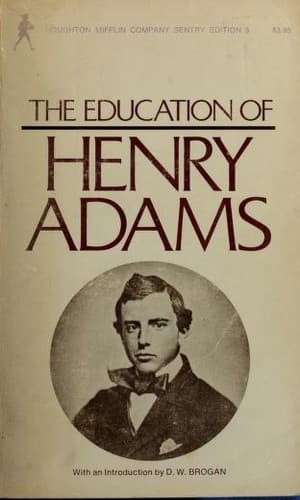
Adams, Henry, 1838-1918; Historians -- United States -- Biography
The world was always good-natured; civil; glad to be amused;
open-armed to any one who amused it; patient with every one who did not
insist on putting himself in its way, or costing it money; but this was
not consideration, still less power in any of its concrete forms, and
applied as well or better to a comic actor. Certainly a rare soprano or
tenor voice earned infinitely more applause as it gave infinitely more
pleasure, even in America; but one does what one can with one's means,
and casting up one's balance sheet, one expects only a reasonable
return on one's capital. Hay and Adams had risked nothing and never
played for high stakes. King had followed the ambitious course. He had
played for many millions. He had more than once come close to a great
success, but the result was still in doubt, and meanwhile he was
passing the best years of his life underground. For companionship he
was mostly lost.
Thus, in 1892, neither Hay, King, nor Adams knew whether they
had attained success, or how to estimate it, or what to call it; and
the American people seemed to have no clearer idea than they. Indeed,
the American people had no idea at all; they were wandering in a
wilderness much more sandy than the Hebrews had ever trodden about
Sinai; they had neither serpents nor golden calves to worship. They had
lost the sense of worship; for the idea that they worshipped money
seemed a delusion. Worship of money was an old-world trait; a healthy
appetite akin to worship of the Gods, or to worship of power in any
concrete shape; but the American wasted money more recklessly than any
one ever did before; he spent more to less purpose than any extravagant
court aristocracy; he had no sense of relative values, and knew not
what to do with his money when he got it, except use it to make more,
or throw it away. Probably, since human society began, it had seen no
such curious spectacle as the houses of the San Francisco millionaires
on Nob Hill. Except for the railway system, the enormous wealth taken
out of the ground since 1840, had disappeared. West of the Alleghenies,
the whole country might have been swept clean, and could have been
replaced in better form within one or two years. The American mind had
less respect for money than the European or Asiatic mind, and bore its
loss more easily; but it had been deflected by its pursuit till it
could turn in no other direction. It shunned, distrusted, disliked, the
dangerous attraction of ideals, and stood alone in history for its
ignorance of the past.
Public-domain text, read in full here on John Shaqi.
Reviews
Reviews
No reviews yet
Be the first to share your thoughts on this work.
Elsewhere in the archive
Join the Discussion
Join the discussion
Sign in to leave a comment or review.
Sign InorCreate an account