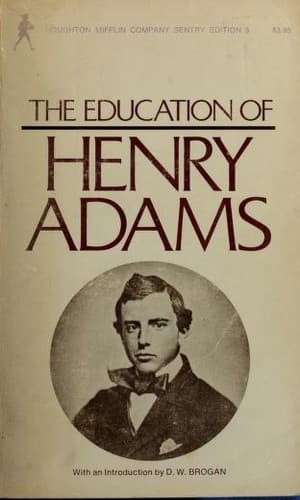
Adams, Henry, 1838-1918; Historians -- United States -- Biography
Personal contact brought this American trait close to Adams's
notice. His first step, on returning to Washington, took him out to the
cemetery known as Rock Creek, to see the bronze figure which St.
Gaudens had made for him in his absence. Naturally every detail
interested him; every line; every touch of the artist; every change of
light and shade; every point of relation; every possible doubt of St.
Gaudens's correctness of taste or feeling; so that, as the spring
approached, he was apt to stop there often to see what the figure had
to tell him that was new; but, in all that it had to say, he never once
thought of questioning what it meant. He supposed its meaning to be the
one commonplace about it--the oldest idea known to human thought. He
knew that if he asked an Asiatic its meaning, not a man, woman, or
child from Cairo to Kamtchatka would have needed more than a glance to
reply. From the Egyptian Sphinx to the Kamakura Daibuts; from
Prometheus to Christ; from Michael Angelo to Shelley, art had wrought
on this eternal figure almost as though it had nothing else to say. The
interest of the figure was not in its meaning, but in the response of
the observer. As Adams sat there, numbers of people came, for the
figure seemed to have become a tourist fashion, and all wanted to know
its meaning. Most took it for a portrait-statue, and the remnant were
vacant-minded in the absence of a personal guide. None felt what would
have been a nursery-instinct to a Hindu baby or a Japanese
jinricksha-runner. The only exceptions were the clergy, who taught a
lesson even deeper. One after another brought companions there, and,
apparently fascinated by their own reflection, broke out passionately
against the expression they felt in the figure of despair, of atheism,
of denial. Like the others, the priest saw only what he brought. Like
all great artists, St. Gaudens held up the mirror and no more. The
American layman had lost sight of ideals; the American priest had lost
sight of faith. Both were more American than the old, half-witted
soldiers who denounced the wasting, on a mere grave, of money which
should have been given for drink.
Public-domain text, read in full here on John Shaqi.
Reviews
Reviews
No reviews yet
Be the first to share your thoughts on this work.
Elsewhere in the archive
Join the Discussion
Join the discussion
Sign in to leave a comment or review.
Sign InorCreate an account