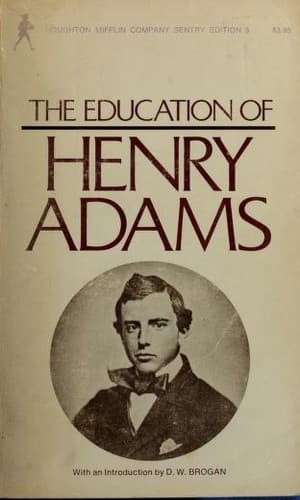
Adams, Henry, 1838-1918; Historians -- United States -- Biography
Landed, lost, and forgotten, in the centre of this vast plain
of self-content, Adams could see but one active interest, to which all
others were subservient, and which absorbed the energies of some sixty
million people to the exclusion of every other force, real or
imaginary. The power of the railway system had enormously increased
since 1870. Already the coal output of 160,000,000 tons closely
approached the 180,000,000 of the British Empire, and one held one's
breath at the nearness of what one had never expected to see, the
crossing of courses, and the lead of American energies. The moment was
deeply exciting to a historian, but the railway system itself
interested one less than in 1868, since it offered less chance for
future profit. Adams had been born with the railway system; had grown
up with it; had been over pretty nearly every mile of it with curious
eyes, and knew as much about it as his neighbors; but not there could
he look for a new education. Incomplete though it was, the system
seemed on the whole to satisfy the wants of society better than any
other part of the social machine, and society was content with its
creation, for the time, and with itself for creating it. Nothing new
was to be done or learned there, and the world hurried on to its
telephones, bicycles, and electric trams. At past fifty, Adams solemnly
and painfully learned to ride the bicycle.
Nothing else occurred to him as a means of new life. Nothing
else offered itself, however carefully he sought. He looked for no
change. He lingered in Washington till near July without noticing a new
idea. Then he went back to England to pass his summer on the Deeside.
In October he returned to Washington and there awaited the reelection
of Mr. Cleveland, which led to no deeper thought than that of taking up
some small notes that happened to be outstanding. He had seen enough of
the world to be a coward, and above all he had an uneasy distrust of
bankers. Even dead men allow themselves a few narrow prejudices.
CHAPTER XXII
CHICAGO (1893)
DRIFTING in the dead-water of the fin-de-siecle--and during
this last decade every one talked, and seemed to feel
fin-de-siecle--where not a breath stirred the idle air of education or
fretted the mental torpor of self-content, one lived alone. Adams had
long ceased going into society. For years he had not dined out of his
own house, and in public his face was as unknown as that of an extinct
statesman. He had often noticed that six months' oblivion amounts to
newspaper-death, and that resurrection is rare. Nothing is easier, if a
man wants it, than rest, profound as the grave.
Public-domain text, read in full here on John Shaqi.
Reviews
Reviews
No reviews yet
Be the first to share your thoughts on this work.
Elsewhere in the archive
Join the Discussion
Join the discussion
Sign in to leave a comment or review.
Sign InorCreate an account