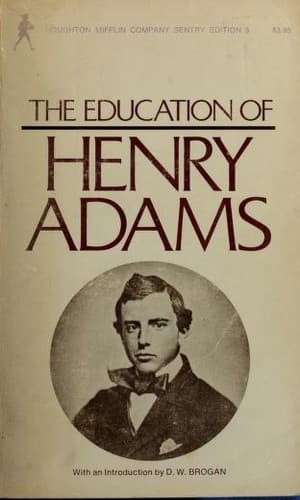
Adams, Henry, 1838-1918; Historians -- United States -- Biography
Boys never see a conclusion; only on the edge of the grave can
man conclude anything; but the first impulse given to the boy is apt to
lead or drive him for the rest of his life into conclusion after
conclusion that he never dreamed of reaching. One looked idly enough at
the Forum or at St. Peter's, but one never forgot the look, and it
never ceased reacting. To a young Bostonian, fresh from Germany, Rome
seemed a pure emotion, quite free from economic or actual values, and
he could not in reason or common sense foresee that it was mechanically
piling up conundrum after conundrum in his educational path, which
seemed unconnected but that he had got to connect; that seemed
insoluble but had got to be somehow solved. Rome was not a beetle to be
dissected and dropped; not a bad French novel to be read in a railway
train and thrown out of the window after other bad French novels, the
morals of which could never approach the immorality of Roman history.
Rome was actual; it was England; it was going to be America. Rome could
not be fitted into an orderly, middle-class, Bostonian, systematic
scheme of evolution. No law of progress applied to it. Not even
time-sequences--the last refuge of helpless historians--had value for
it. The Forum no more led to the Vatican than the Vatican to the Forum.
Rienzi, Garibaldi, Tiberius Gracchus, Aurelian might be mixed up in any
relation of time, along with a thousand more, and never lead to a
sequence. The great word Evolution had not yet, in 1860, made a new
religion of history, but the old religion had preached the same
doctrine for a thousand years without finding in the entire history of
Rome anything but flat contradiction.
Of course both priests and evolutionists bitterly denied this
heresy, but what they affirmed or denied in 1860 had very little
importance indeed for 1960. Anarchy lost no ground meanwhile. The
problem became only the more fascinating. Probably it was more vital in
May, 1860, than it had been in October, 1764, when the idea of writing
the Decline and Fall of the city first started to the mind of Gibbon,
"in the close of the evening, as I sat musing in the Church of the
Zoccolanti or Franciscan Friars, while they were singing Vespers in the
Temple of Jupiter, on the ruins of the Capitol." Murray's Handbook had
the grace to quote this passage from Gibbon's "Autobiography," which
led Adams more than once to sit at sunset on the steps of the Church of
Santa Maria di Ara Coeli, curiously wondering that not an inch had been
gained by Gibbon--or all the historians since--towards explaining the
Fall. The mystery remained unsolved; the charm remained intact. Two
great experiments of Western civilization had left there the chief
monuments of their failure, and nothing proved that the city might not
still survive to express the failure of a third.
Public-domain text, read in full here on John Shaqi.
Reviews
Reviews
No reviews yet
Be the first to share your thoughts on this work.
Elsewhere in the archive
Join the Discussion
Join the discussion
Sign in to leave a comment or review.
Sign InorCreate an account