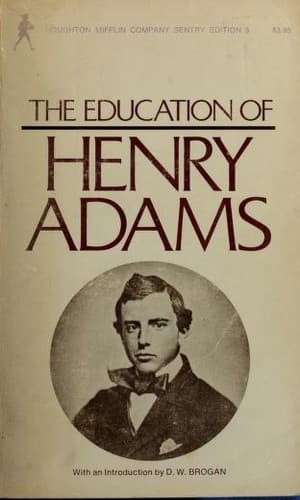
Adams, Henry, 1838-1918; Historians -- United States -- Biography
The young man had no idea what he was doing. The thought of
posing for a Gibbon never entered his mind. He was a tourist, even to
the depths of his sub-consciousness, and it was well for him that he
should be nothing else, for even the greatest of men cannot sit with
dignity, "in the close of evening, among the ruins of the Capitol,"
unless they have something quite original to say about it. Tacitus
could do it; so could Michael Angelo; and so, at a pinch, could Gibbon,
though in figure hardly heroic; but, in sum, none of them could say
very much more than the tourist, who went on repeating to himself the
eternal question:--Why! Why!! Why!!!--as his neighbor, the blind
beggar, might do, sitting next him, on the church steps. No one ever
had answered the question to the satisfaction of any one else; yet
every one who had either head or heart, felt that sooner or later he
must make up his mind what answer to accept. Substitute the word
America for the word Rome, and the question became personal.
Perhaps Henry learned something in Rome, though he never knew
it, and never sought it. Rome dwarfs teachers. The greatest men of the
age scarcely bore the test of posing with Rome for a background.
Perhaps Garibaldi--possibly even Cavour--could have sat "in the close
of the evening, among the ruins of the Capitol," but one hardly saw
Napoleon III there, or Palmerston or Tennyson or Longfellow. One
morning, Adams happened to be chatting in the studio of Hamilton Wilde,
when a middle-aged Englishman came in, evidently excited, and told of
the shock he had just received, when riding near the Circus Maximus, at
coming unexpectedly on the guillotine, where some criminal had been put
to death an hour or two before. The sudden surprise had quite overcome
him; and Adams, who seldom saw the point of a story till time had
blunted it, listened sympathetically to learn what new form of grim
horror had for the moment wiped out the memory of two thousand years of
Roman bloodshed, or the consolation, derived from history and
statistics, that most citizens of Rome seemed to be the better for
guillotining. Only by slow degrees, he grappled the conviction that the
victim of the shock was Robert Browning; and, on the background of the
Circus Maximus, the Christian martyrs flaming as torches, and the
morning's murderer on the block, Browning seemed rather in place, as a
middle-aged gentlemanly English Pippa Passes; while afterwards, in the
light of Belgravia dinner-tables, he never made part of his background
except by effacement. Browning might have sat with Gibbon, among the
ruins, and few Romans would have smiled.
Public-domain text, read in full here on John Shaqi.
Reviews
Reviews
No reviews yet
Be the first to share your thoughts on this work.
Elsewhere in the archive
Join the Discussion
Join the discussion
Sign in to leave a comment or review.
Sign InorCreate an account