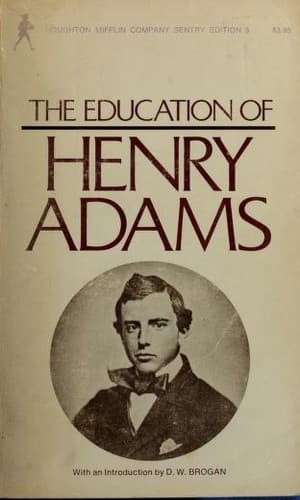
Adams, Henry, 1838-1918; Historians -- United States -- Biography
Private secretaries are servants of a rather low order, whose
business is to serve sources of power. The first news of a professional
kind, imparted to private secretary Adams on reaching Washington, was
that the President-elect, Abraham Lincoln, had selected Mr. Seward for
his Secretary of State, and that Seward was to be the medium for
communicating his wishes to his followers. Every young man naturally
accepted the wishes of Mr. Lincoln as orders, the more because he could
see that the new President was likely to need all the help that several
million young men would be able to give, if they counted on having any
President at all to serve. Naturally one waited impatiently for the
first meeting with the new Secretary of State.
Governor Seward was an old friend of the family. He professed
to be a disciple and follower of John Quincy Adams. He had been Senator
since 1849, when his responsibilities as leader had separated him from
the Free Soil contingent, for, in the dry light of the first Free Soil
faith, the ways of New York politics Thurlow Weed had not won favor;
but the fierce heat which welded the Republican Party in 1856 melted
many such barriers, and when Mr. Adams came to Congress in December,
1859, Governor Seward instantly renewed his attitude of family friend,
became a daily intimate in the household, and lost no chance of forcing
his fresh ally to the front.
A few days after their arrival in December, 1860, the Governor,
as he was always called, came to dinner, alone, as one of the family,
and the private secretary had the chance he wanted to watch him as
carefully as one generally watches men who dispose of one's future. A
slouching, slender figure; a head like a wise macaw; a beaked nose;
shaggy eyebrows; unorderly hair and clothes; hoarse voice; offhand
manner; free talk, and perpetual cigar, offered a new type--of western
New York--to fathom; a type in one way simple because it was only
double--political and personal; but complex because the political had
become nature, and no one could tell which was the mask and which the
features. At table, among friends, Mr. Seward threw off restraint, or
seemed to throw it off, in reality, while in the world he threw it off,
like a politician, for effect. In both cases he chose to appear as a
free talker, who loathed pomposity and enjoyed a joke; but how much was
nature and how much was mask, he was himself too simple a nature to
know. Underneath the surface he was conventional after the conventions
of western New York and Albany. Politicians thought it
unconventionality. Bostonians thought it provincial. Henry Adams
thought it charming. From the first sight, he loved the Governor, who,
though sixty years old, had the youth of his sympathies. He noticed
that Mr. Seward was never petty or personal; his talk was large; he
generalized; he never seemed to pose for statesmanship; he did not
require an attitude of prayer. What was more unusual--almost singular
Public-domain text, read in full here on John Shaqi.
Reviews
Reviews
No reviews yet
Be the first to share your thoughts on this work.
Elsewhere in the archive
Join the Discussion
Join the discussion
Sign in to leave a comment or review.
Sign InorCreate an account