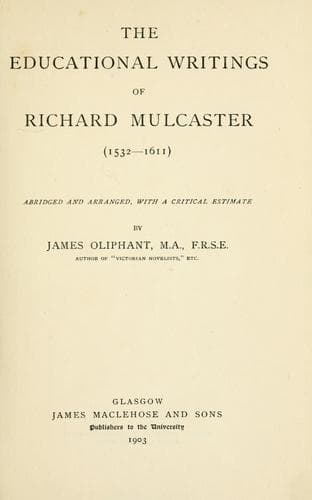
The Educational Writings of Richard MulcasterMulcaster, Richard
History
The Educational Writings of Richard Mulcaster
Mulcaster, Richard
Education -- History
The third question, as to my writing in English, and my being so
careful--I will not say fastidious--in expression, concerns me more
nearly, for it has some importance. It is the opinion of some that
we should not treat any philosophical subject, or any ordinary
subject in a philosophical manner, in the English tongue, because
the unlearned find it too difficult to understand in any case, and
the learned, holding it in little esteem, get no pleasure from it.
In regard both to writing in English generally, and my own writing
in particular, I have this to say: No one language is finer than
any other naturally, but each becomes cultivated by the efforts of
the speaker who, using such opportunities as are afforded by the
kind of government under which he lives, endeavours to garnish it
with eloquence, and enrich it with learning. Such a tongue, elegant
in form and learned in matter, while it keeps within its natural
soil, not only serves its immediate purpose with just admiration,
but in foreigners who become acquainted with it, it kindles a great
desire to have their own language resemble it. Thus it came to pass
that the people of Athens beautified their speech in the practice
of pleading, and enriched it with all kinds of knowledge, bred both
within Greece and outside of it. Thus it came to pass that the
people of Rome, having formed their practice in imitation of the
Athenian, became enamoured with the eloquence of those from whom
they were borrowing, and translated their learning also. However,
there was not nearly the same amount of learning in the Latin
tongue during the time of the Romans as there is at this day by the
industry of students throughout the whole of Europe, who use Latin
as a common means of expression, both in original works and in
translations. Roman authority first planted Latin among us here,
by force of their conquest, and its use in matters of learning
causes it to continue. Therefore the so-called Latin tongues have
their own peoples to thank, both for their own cultivation at
home and for the favour they enjoy abroad. So it falls out that,
as we are profited by means of these tongues, we should pay them
honour, and yet not without cherishing our own, in regard both to
cases where the usage is best and to those where it is open to
improvement. For did not these tongues use even the same means
to cultivate themselves before they proved so beautiful? Did the
people shrink from putting into their own language the ideas they
borrowed from foreign sources? If they had done so, we should never
have had the works we so greatly admire.
Public-domain text, read in full here on John Shaqi.
Reviews
Reviews
No reviews yet
Be the first to share your thoughts on this work.
Elsewhere in the archive
Join the Discussion
Join the discussion
Sign in to leave a comment or review.
Sign InorCreate an account