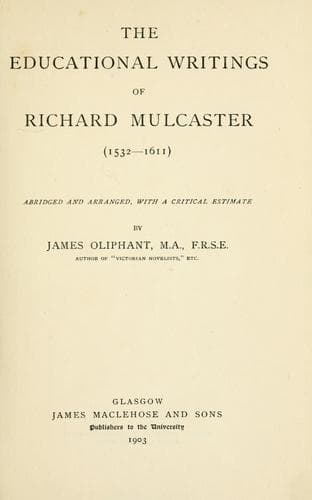
The Educational Writings of Richard MulcasterMulcaster, Richard
History
The Educational Writings of Richard Mulcaster
Mulcaster, Richard
Education -- History
There are two chief reasons which keep Latin, and to some extent
other learned tongues, in high consideration among us,--the
knowledge which is registered in them, and their use as a means
of communication, in both speaking and writing, by the learned
class throughout Europe. While these two benefits are retained,
if there is anything else that can be done with our own tongue,
either in beautifying it, or in turning it to practical account,
we cannot but take advantage of it, even though Latin should thus
be displaced, as it displaced others, bequeathing its learning to
us. For is it not indeed a marvellous bondage, to become servants
to one tongue for the sake of learning, during the greater part
of our time, when we can have the very same treasure in our own
language, which forms the joyful title to our liberty, as the Latin
reminds us of our thraldom? I love Rome, but I love London better;
I favour Italy, but I favour England more; I honour the Latin
tongue, but I worship the English. I wish everything were in our
tongue which the learned tongues gained from others, nor do I wrong
them in treating them as they did their predecessors, teaching us
by their example how boldly we may venture, notwithstanding the
opinion of some among us, who desire rather to please themselves
with a foreign language that they know, than to profit their
country in their own language, which they ought to know. It is
no argument to say: Will you dishonour those tongues which have
honoured you, and without which you could never have enjoyed the
learning of which you propose to rob them? For I honour them still,
as much as any one, even in wishing my own tongue to be a partaker
of their honour. For if I did not hold them in great admiration,
because I know their value, I would not think it any honour for
my own language to imitate their grace. I wish we had the stores
with which they furnished themselves from foreign sources. For
the tongues that we study were not the first getters, though by
learned labour they prove to be good keepers, and they are ready to
discharge their trust, in handing on to others what was committed
to them for a term, and not in perpetuity. There can be no
disgrace in their delivering to others what they received on that
understanding. The dishonour will lie rather with the tongue that
refuses to receive the inheritance intended for it and duly offered
to it, and from this dishonour I would our language were free. I
admit the good fortune of those tongues that had so great a start
over others that they are most welcome wherever they set foot, and
are always admired for their rare excellence, disposing all men to
think little of any form of speech that does not resemble them, and
to rank even the best of these as marvellously behind them. The
diligent labour of the learned men of ancient times so enriched
their tongues that they proved very pliable, as I am assured our
own will prove, if our learned fellow-countrymen will bestow their
Public-domain text, read in full here on John Shaqi.
Reviews
Reviews
No reviews yet
Be the first to share your thoughts on this work.
Elsewhere in the archive
Join the Discussion
Join the discussion
Sign in to leave a comment or review.
Sign InorCreate an account