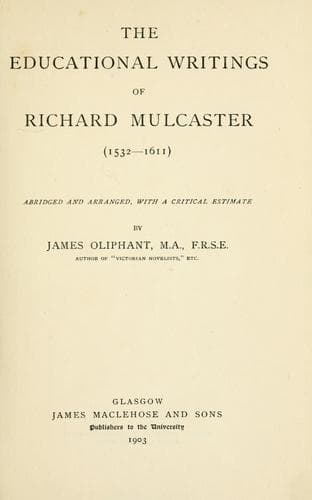
The Educational Writings of Richard MulcasterMulcaster, Richard
History
The Educational Writings of Richard Mulcaster
Mulcaster, Richard
Education -- History
labour on it. And why, I pray you, should such labour not be
bestowed on English, as well as on Latin or any other language?
Will you say it is needless? Certainly that will not hold. If loss
of time over tongues, while you are pilgrims to learning, is no
injury, or lack of sound skill, while language distracts the mind
from the sense, especially with the foolish and inexperienced, then
there might be some ground for holding it needless. But since there
was no need for the present loss of time in study through labouring
with tongues, and since our understanding is more perfect in our
natural speech, however well we may know the foreign language,
methinks necessity itself calls for English, by which all that
bravery may be had at home that makes us gaze so much at the fine
stranger. But you will say it is uncouth; so it is, through being
unused. So was it with Latin, and so it is with every language.
Cicero himself, the paragon of Rome while he was alive, and our
best pattern now though he is dead, had great wrestling with such
wranglers, and their disdain of their natural speech, before he won
from the public of his time the opinion in which he was held by the
best of his friends then, and is held by us now. Are not all his
prefaces to his philosophical writings full of such conflicts with
these cavillers? English wits are very well able, thank God, if the
good will were present, to make that uncouth and unknown learning
very familiar to our people in our own tongue, even by the example
of those very writers we esteem so highly, who having done for
other languages what I wish for ours in the like case, must needs
approve of us, unless they assert that the merit of conveying
knowledge from a foreign tongue died with them, not to revive
among us. But whatever they may say to continue their own credit,
our fellow-countrymen cannot but think that it is our praise to
obtain by purchase and transplanting into our own tongue what they
were so desirous to place in theirs, and are now so loth to forgo
again; it is indeed the fairest flower of their whole garland, for
these tongues would wither soon, or decay altogether, but for the
great knowledge contained therein. If our people were not readier
to wonder at their workmanship than to take trouble with their own
tongue, they might have the same advantage. Our English is our own,
and must be used by those to whom it belongs, as were those others
that were ranked with the best.
Public-domain text, read in full here on John Shaqi.
Reviews
Reviews
No reviews yet
Be the first to share your thoughts on this work.
Elsewhere in the archive
Join the Discussion
Join the discussion
Sign in to leave a comment or review.
Sign InorCreate an account