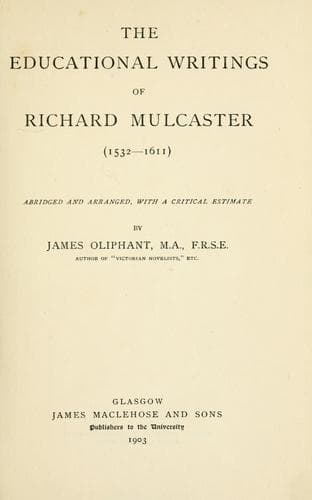
The Educational Writings of Richard MulcasterMulcaster, Richard
History
The Educational Writings of Richard Mulcaster
Mulcaster, Richard
Education -- History
But it may be replied that our English tongue is not worthy of such
cultivation, because it has so little extent, stretching no further
than this island of ours, and not even over the whole of that. What
though this be true? Still it reigns here and serves our purpose;
it should be brushed clean in order to be worn. Are not English
folk, I pray you, as particular as foreigners? And is not as much
taste needed for our tongue in speaking, and our pen in writing, as
for apparel and diet? But, it will be said, our State is no empire,
hoping to enlarge itself by ruling other countries. What then?
Though it be neither large in possession, nor in present hope of
great increase, yet where it rules it can make good laws to suit
its position, as well as the largest country can, and often better,
since in the greatest governments there is often confusion.
But again, it will be urged, we have no rare knowledge belonging
to our soil to make foreigners study our tongue as a treasure of
such store. What of that? We are able by its means to apply to our
use all the great treasure both of foreign soil and of foreign
language. And why may not English wits, if they will bend their
wills to seek matter and method, be as much sought after by foreign
students for the increase of their knowledge as our soil is already
sought after by foreign merchants for the increase of their wealth?
As the soil is fertile because it is cultivated, so the wits are
not barren, if they choose to bring forth.
Yet though all this be true, we are in despair of ever seeing our
own language so refined as were those where public orations were
held in ordinary course, and the very tongue itself made a chariot
to honour. Our State is a monarchy, which controls language, and
teaches it to please; our religion is Christian, and prefers the
naked truth to refinement of terms. What then? If for want of
that exercise which the Athenian and the Roman enjoyed in their
spacious courts, no Englishman should prove to be a Cicero or a
Demosthenes, yet in truth he may prove comparable to them in his
own commonwealth and in the eloquence that befits it. And why not
indeed comparable to them in all points that concern his natural
tongue? Our brain can bring forth; our ideas will bear life; our
tongues are not tied, and our labour is our own. And eloquence
itself is limited neither to one language nor to one soil; the
whole world is its measure, and the wise ear is its judge, having
regard not to greatness of state, but to the capacity of the
people. And even though we should despair of altogether rivalling
the excellence of foreign tongues, must our own therefore be
unbeautified? It should certainly strive to reach its best if I
could help. We may aspire to come to a certain height, even though
we can pass no further. The nature of our government will admit
true speaking and writing, and eloquence will be approved if it
gives pleasure and is worthy of praise, so long as it preaches
Public-domain text, read in full here on John Shaqi.
Reviews
Reviews
No reviews yet
Be the first to share your thoughts on this work.
Elsewhere in the archive
Join the Discussion
Join the discussion
Sign in to leave a comment or review.
Sign InorCreate an account